

What If Your Insomnia Starts at Sunrise?
The Sunrise 8-3-1 sleep protocol that begins with morning light and ends with a pen and paper

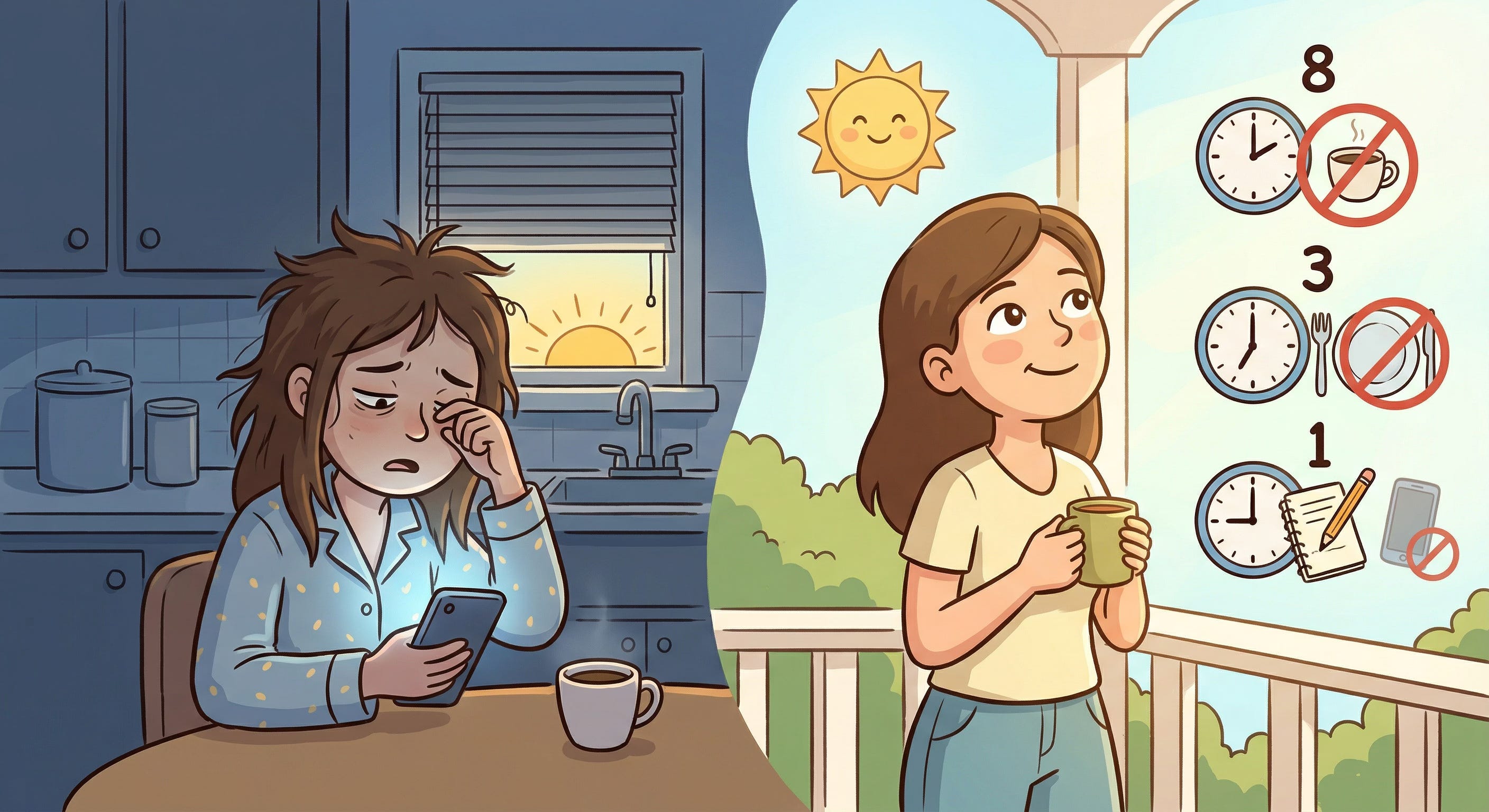
If you are lying awake at midnight, your problem probably started twelve hours ago.
That is the part most sleep advice gets backwards. The entire industry is built around bedtime, and the recommendations all sound the same. Dim the lights, put the phone down, take magnesium, buy a better mattress. And those things matter, which is why we will get to them. But the research keeps pointing to a different starting line. Your worst night of sleep may have been decided in the first thirty minutes after your alarm went off.
Think about your own morning. Did you go outside? Or did you check your phone in bed, make coffee in a dim kitchen, and get to work without spending any real time outdoors? Even with sunlight coming through windows, indoor light at your eyes is dramatically dimmer than being outside, and the circadian system cares about intensity, timing, and duration. If your morning routine keeps you indoors, you missed the most powerful daily signal your body needs to produce melatonin on schedule fourteen hours later. Your body never got a clear “start the clock” signal. So by 10 PM, when you want to feel drowsy, the system is still running behind.
The fix is a protocol that starts at sunrise and works both ends of the day.
The protocol is called Sunrise 8-3-1
Sunrise 8-3-1 is a bookend protocol that works the morning and the evening as a unit. SUNRISE means getting morning light within 30 minutes of waking. The 8 is the number of hours before bed to stop caffeine, the 3 is hours before bed to finish your last meal, and the 1 is the hour before bed when screens go off and a pen comes out. Four levers, one protocol, and they work together.
The morning side
Behind your eyes, buried deep in the brain, sits a cluster of about 20,000 neurons called the suprachiasmatic nucleus. It is the size of a grain of rice and it runs your entire circadian system. Body temperature, hormone release, digestion, immune function, when you feel alert, and when you feel sleepy all answer to this clock.
The clock needs a daily reset signal, and that signal is light.
When morning sunlight enters your eyes, it does not take the same path as the light you use for reading or recognizing faces. Specialized cells in the retina called intrinsically photosensitive retinal ganglion cells (you do not need to remember that name) detect the blue-spectrum wavelengths abundant in daylight and send a direct signal to the suprachiasmatic nucleus. Two things happen almost immediately.
First, cortisol naturally rises after waking in what is called the cortisol awakening response. This is not the chronic stress cortisol that causes problems. It is a sharp morning pulse that tells your body it is time to be alert, and morning bright light amplifies that signal. Second, the light starts a countdown. Roughly fourteen to sixteen hours later, that same system will instruct the pineal gland to begin releasing melatonin, the hormone that makes you feel sleepy in the evening.
If you skip the morning light, the timer never starts cleanly. The cortisol spike drifts later or flattens out entirely, and the evening melatonin release drifts with it. You end up feeling groggy in the morning and wired at night because your body never got a clear “go” signal at dawn.
Researchers tested this by taking a group of adults camping in the Rocky Mountains for one week. No flashlights, no phones, no artificial light of any kind. By the end of the week, their melatonin onset had shifted approximately two hours earlier, aligning with sunset. The finding that stood out was that during their normal lives at home, these same participants received more than four times less light during the day than they did outdoors, and far more light in the evening. Their clocks were being pushed later in both directions.
Research on office workers has linked higher morning light exposure to faster sleep onset and better overall sleep quality scores. Controlled lab studies show that bright light shortly after waking produces a measurable cortisol surge that does not occur when the same light is delivered in the afternoon. The timing matters because morning light advances the clock while evening light delays it.
The practical piece is simple. Go outside within 30 minutes of waking for five to ten minutes of natural light, and leave the sunglasses inside because they block the wavelengths your retinal cells need. Overcast days still deliver far more circadian-effective light than any indoor fixture. Even heavy cloud cover produces several thousand lux at your eyes, compared to a few hundred lux from a bright kitchen light. That morning walk to the mailbox or five minutes with your coffee on the porch covers the SUNRISE portion of the protocol.
The 8
Most people have a vague sense that they should not drink coffee too late in the day. “Nothing after 2 PM” is a common guideline, though nobody can quite remember where it came from.
A systematic review and meta-analysis pooled data from 24 studies and calculated the minimum time buffer between a standard cup of coffee and bedtime required to avoid measurable reductions in total sleep time. The number they arrived at was 8.8 hours, which is far longer than the six-hour cutoff most people assume.
That same review documented the aggregate cost of ignoring the cutoff. Across the included studies, caffeine reduced total sleep time by 45 minutes, decreased sleep efficiency by 7 percent, and increased wakefulness after sleep onset by 12 minutes. People often reported sleeping fine even when objective measurements showed otherwise. Their sleep was shorter, lighter, and more fragmented, but they could not feel the difference. They just woke up tired and blamed something else.
The reason the number is so high has to do with how the body processes caffeine. Caffeine works by blocking adenosine receptors in the brain. Adenosine is the molecule that accumulates during waking hours and creates sleep pressure. Block it, and you feel alert. But caffeine does not disappear quickly. Its half-life in healthy adults ranges from about two hours in fast metabolizers to ten hours in slow ones. The average is around five to six hours, meaning that half the caffeine from your 2 PM cup is still circulating at 8 PM. A quarter is still there at 2 AM.
Genetics plays a big role in where you fall on that spectrum, and so do hormonal factors. Oral contraceptives roughly double caffeine’s half-life, and pregnancy can triple it. If you have ever noticed that coffee hits you harder or lasts longer than it does for other people, your liver metabolizes probably on the slower end.
Eight hours is the evidence-based floor. For a 10 PM bedtime, that means last coffee at 2 PM. If you are a slow metabolizer or you drink large servings, the real number may be closer to ten or twelve hours. Count backward from your bedtime, and you have the 8 in the protocol.
The 3
Most people accept that stimulants close to bedtime are a problem. Fewer people realize that food timing matters nearly as much, and for a completely different reason.
In the two to three hours before your habitual bedtime, your body begins preparing for sleep. Part of that preparation involves shifting how it handles fuel. Research shows that melatonin, the same hormone preparing your brain for sleep, also acts on receptors in the pancreas to reduce insulin output. When a large randomized trial measured melatonin levels during late versus early dinners, participants eating close to bedtime had melatonin levels more than three times higher, and their glucose and insulin responses were significantly worse. Glucose tolerance drops, fat oxidation slows, and the whole system begins winding down. This is normal and expected when you are not eating. The problem starts when you add a meal to the mix.
If you eat a full meal during this window, you are handing your body a metabolic project at the worst possible time. Glucose stays elevated longer because insulin cannot keep up, triglyceride clearance is delayed, and the body burns less of the dietary fat it just received. You are lying in bed while your bloodstream looks like it did right after lunch.
A randomized crossover trial tested this directly. Twenty healthy young adults ate the same meal on two separate lab visits, once at 6 PM and once at 10 PM, with a fixed sleep period from 11 PM to 7 AM. When dinner was late, participants had significantly higher nocturnal glucose, elevated cortisol through the night, and reduced fat burning while they slept. Conventional sleep staging showed no dramatic differences between the two nights, which is part of what makes this finding so important. You can eat late and still appear to sleep normally on a lab report. But the metabolic profile during sleep shifts in an unfavorable direction, and if that pattern repeats night after night, the effects may accumulate.
The study also revealed something interesting about individual vulnerability. The participants who were naturally earlier sleepers showed the largest metabolic disruptions from late eating. If you tend to feel sleepy by 9 or 10 PM, your body may be particularly sensitive to meals that run up against that window.
How your body handles glucose depends not just on what you eat, but on when you eat relative to your internal clock. Meal timing and blood sugar regulation are connected around the clock, and the hours closest to sleep are when your metabolism is least equipped to handle a full plate of food.
Finish your last meal at least three hours before bed. The research compared eating one hour before bed versus five hours before, so three hours is a conservative practical target between those two points. If you are in bed by 10, dinner wraps up by 7, which gives your body time to clear the postprandial period before sleep deepens.
The 1
You have handled the morning with sunlight, the afternoon with a caffeine cutoff, and the evening with meal timing. Now comes the final hour, and the screens go off.
The reason screens interfere with sleep goes beyond the commonly cited blue light effect. Yes, light from phones and laptops suppresses melatonin. But the content is equally disruptive. Email, news feeds, group chats, and social media keep the prefrontal cortex in problem-solving mode. The brain does not shift from “engaged and evaluating” to “falling asleep” the way you flip a light switch. It needs a ramp-down period, and scrolling through your phone at 10:45 PM provides the opposite.
So what do you do with that hour instead? You pick up a pen. There are two options, and both have evidence behind them.
The brain dump. Researchers brought healthy young adults into a sleep lab for an overnight study. Five minutes before lights out, participants were randomly assigned to one of two writing tasks. One group wrote a to-do list of everything they needed to accomplish in the next few days, and the other wrote about activities they had already completed that day. Polysomnography, the gold standard for measuring sleep, tracked exactly how long it took each person to fall asleep.
The to-do list group fell asleep significantly faster. And the more specific and detailed their lists were, the quicker they dropped off.
The proposed explanation is cognitive offloading. Unfinished tasks create a low-level mental loop, with your brain circling back to things left undone and rehearsing them so you will not forget. Writing them down on paper closes that loop. The tasks are not gone, but they are stored somewhere outside your head, and your brain can let go of them for the night.
The gratitude journal. A large study of over 400 adults found that people who scored higher on measures of trait gratitude reported better sleep quality, shorter time to fall asleep, and longer sleep duration, even after the researchers statistically removed the effects of personality traits like anxiety and neuroticism. The relationship ran through a specific channel. Grateful people had more positive thoughts and fewer worried, anxious thoughts in the minutes before falling asleep. That finding is correlational, not experimental, but it points to something practical. What occupies your mind in those last few minutes before sleep appears to matter, and a short gratitude practice is a low-risk way to test whether shifting that mental content helps you.
What runs through your mind as you close your eyes shapes how quickly you fall asleep and how well you stay asleep. The to-do list empties the worry queue, and the gratitude journal fills that space with something better. You can do one or the other, or a few lines of each. Either way, screens go off one hour before bed and you spend five minutes with pen and paper. That final hour is the last piece of the protocol.
The full protocol
SUNRISE Within 30 minutes of waking, go outside for 5 to 10 minutes of natural light. No sunglasses.
8 Last caffeine at least 8 hours before your target bedtime.
3 Last meal at least 3 hours before bed.
1 One hour before bed, screens off. Five minutes of pen-and-paper writing. A to-do list, a gratitude journal, or both.
The morning and the evening work as a pair. Fixing only the bedtime side solves half the problem, and fixing only the morning does the same. This protocol works because each piece reinforces the others. Morning light sets the melatonin timer, the caffeine and meal cutoffs protect the hours when that melatonin is supposed to be rising, and the pen-and-paper shutdown clears the mental noise that would otherwise override the whole system.
Start this Monday by picking whichever piece feels most doable, then add the others over the week. By Friday, you will have the full protocol running.

References:
Wright KP Jr, McHill AW, Birks BR, Griffin BR, Rusterholz T, Chinoy ED. Entrainment of the human circadian clock to the natural light-dark cycle. Curr Biol. 2013;23(16):1554-1558. doi:10.1016/j.cub.2013.06.039
Gardiner C, Weakley J, Burke LM, et al. The effect of caffeine on subsequent sleep: A systematic review and meta-analysis. Sleep Med Rev. 2023;69:101764. doi:10.1016/j.smrv.2023.101764
Scullin MK, Krueger ML, Ballard HK, Pruett N, Bliwise DL. The effects of bedtime writing on difficulty falling asleep: A polysomnographic study comparing to-do lists and completed activity lists. J Exp Psychol Gen. 2018;147(1):139-146. doi:10.1037/xge0000374
Wood AM, Joseph S, Lloyd J, Atkins S. Gratitude influences sleep through the mechanism of pre-sleep cognitions. J Psychosom Res. 2009;66(1):43-48. doi:10.1016/j.jpsychores.2008.09.002
Gu C, Brereton N, Schweitzer A, et al. Metabolic Effects of Late Dinner in Healthy Volunteers-A Randomized Crossover Clinical Trial. J Clin Endocrinol Metab. 2020;105(8):2789-2802. doi:10.1210/clinem/dgaa354
Garaulet M, Lopez-Minguez J, Dashti HS, et al. Interplay of Dinner Timing and MTNR1B Type 2 Diabetes Risk Variant on Glucose Tolerance and Insulin Secretion: A Randomized Crossover Trial. Diabetes Care. 2022;45(3):512-519. doi:10.2337/dc21-1314
My question has to do with screens. Do yellow and red filters work to reduce blue light emissions, including the yellow filter built into my reading glasses enough to make a difference?
Thx as always
Laurie, I am assuming after screens off and at least 5 minutes of either or both kinds of writing, you can spend the remaining time left in the hour before bed reading before your bedtime.
Am I correct or did I miss something,