


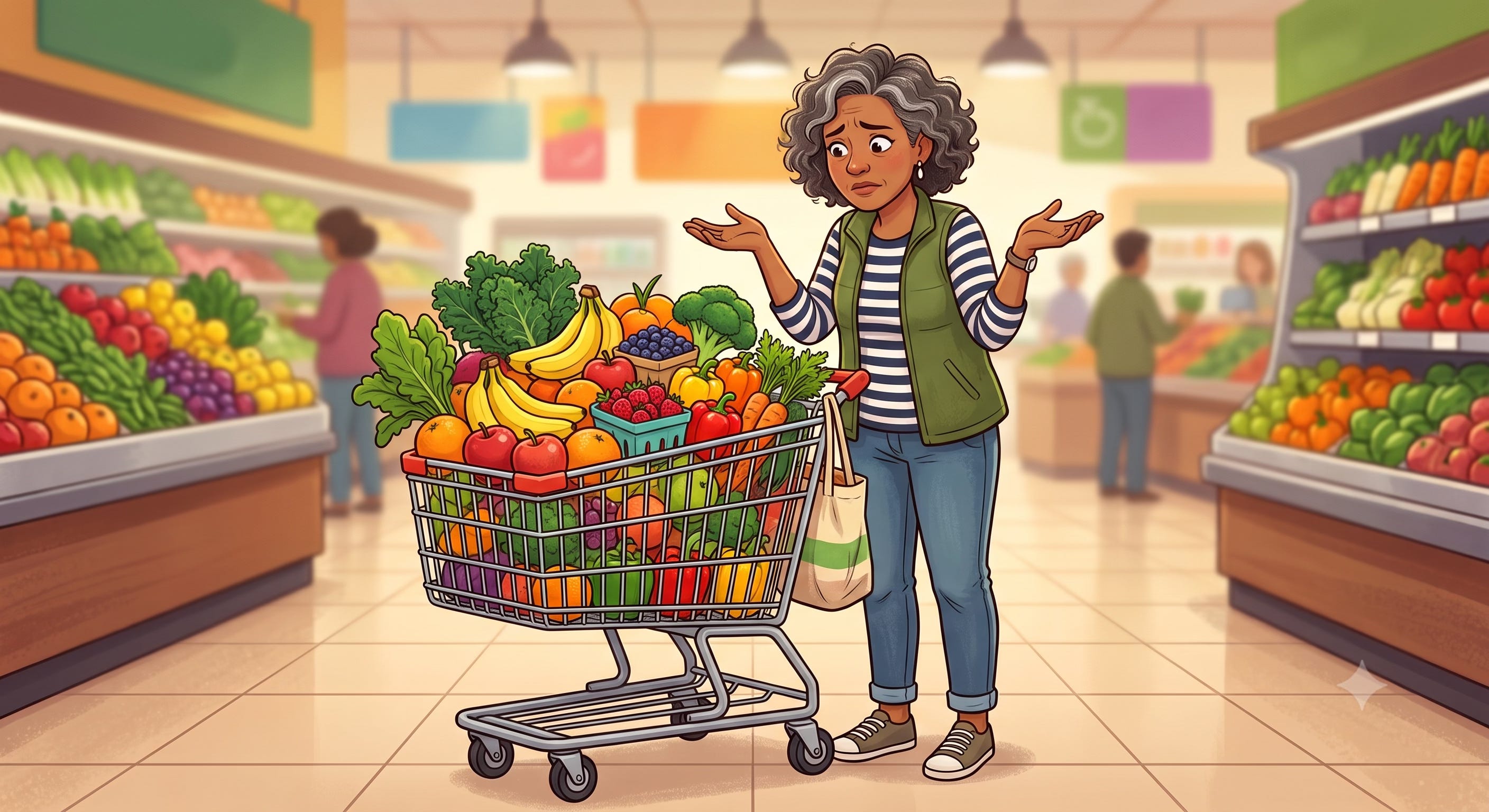
She is standing in the produce aisle on a Saturday morning, loading up on kale and blueberries and those little containers of raspberries that cost too much but she buys anyway because she knows they are good for her. She has been doing this for years. Her cart looks like a textbook example of healthy eating and honestly it mostly is. Her labs come back fine. Her doctor tells her to keep doing what she is doing.
If you recognize yourself in that, if you have spent years building a diet you feel genuinely good about and you have no reason to believe anything is missing, what I am about to show you is going to be uncomfortable. Because there is a specific compound linked to one of the largest reductions in heart disease death ever measured in a major clinical trial, and the dietary advice you have been following, eat five servings of fruits and vegetables a day and you are covered, was never designed to tell you whether you are getting enough of it.
This has nothing to do with trendy superfoods or overpriced supplements. This is about a specific compound that most people are not getting enough of even when their diet looks great on paper, and what the evidence now shows is happening to your cardiovascular system, your brain, your exercise capacity, and your skin while that gap stays open.
The Spectrum That Wasn’t Complete
Did you know that white light, the light coming from the sun, is actually all colors mixed together? When you pass it through a glass prism, the prism separates those colors and spreads them into a band. Red on one end, violet on the other, every color in between. That band of separated colors is basically what a rainbow is. (A rainbow in the sky is the same thing, just with water droplets acting as tiny prisms instead of glass.)
In the early 1800s, an English chemist named William Wollaston did exactly this. He passed sunlight through a prism expecting to see a smooth, continuous band of color. What he saw instead was strange. Scattered through that rainbow were thin dark lines, specific gaps where certain colors were just absent. The overall band looked fine if you stepped back. But up close, pieces were missing.
Wollaston assumed they were natural boundaries between color regions and moved on. About a dozen years later a Bavarian glassmaker named Joseph von Fraunhofer built a much more precise instrument and mapped 574 of those dark lines, cataloging their exact positions with extraordinary care. He still had no idea what they were.
It took another 45 years. In 1859 two German physicists named Kirchhoff and Bunsen (yes, the Bunsen burner Bunsen) figured out what was happening. If nothing interfered with sunlight on its way to Earth, that band of color would be perfectly smooth and continuous, every wavelength present, no gaps. But sunlight has to pass through the sun’s own atmosphere before it reaches us. And the gases in that atmosphere, hydrogen, iron, sodium, calcium, each absorb very specific wavelengths of light. Hydrogen grabs its wavelengths and removes them. Iron grabs a different set and removes those. Each element has its own unique pattern of wavelengths it absorbs, like a barcode.
So by the time the sunlight reaches Earth and you spread it out with a prism, the absorbed wavelengths are gone. They show up as thin dark lines in the rainbow, in very specific positions. Each dark line is a chemical element in the sun’s atmosphere saying “I was here, I took this one.” Read the pattern of dark lines and you are reading the sun’s ingredient list, from 93 million miles away, without ever going there. (This is actually how helium was discovered. Scientists found a dark line in the solar spectrum that did not match any known element on Earth, so they named it after the Greek word for the sun, helios. They identified an element on the sun before anyone found it here.)
The “complete” rainbow of sunlight had never been complete. It was full of invisible gaps that you could only see with the right instrument, and those gaps turned out to carry more useful information than the bright colors themselves.
Something very similar happened in nutrition. The instrument that revealed it was not a prism. It was a biomarker.
The Gap Nobody Expected
In a study published in June of 2026, researchers used two validated urinary biomarkers to measure flavanol intake in more than 30,000 adults across two large cohorts, one in the US and one in the UK. This was not a food diary study where people try to remember what they ate last Tuesday. This was measurement of actual metabolites in urine, basically the molecular fingerprint of what the body had recently absorbed and processed.
The question they were asking was straightforward. Do people who follow standard dietary guidelines, the ones telling us to eat five or more servings of fruits and vegetables every day, actually reach the flavanol intake level that reduced cardiovascular death by 27% in the largest randomized polyphenol trial ever conducted?
Fewer than one in four.
In the US cohort, only 19.2% of all participants hit a biomarker-estimated intake of 500 mg per day. Among people in the top quartile of fruit and vegetable consumption, the ones eating the most produce, that number only climbed to 21%. The heaviest produce eaters did barely better than the general population.
In the UK cohort it was worse. People in the highest quartile of fruit and vegetable intake were actually less likely to reach 500 mg than people in the lowest quartile. The effect was modest in absolute terms but it held up after adjusting for age, sex, and BMI, and the direction was consistent. The specific fruits and vegetables people chose determined the outcome far more than the total volume they consumed.
That runs directly against something most of my patients believe, which is that if you fill your plate with produce, you are automatically covered. You are not.
Why the Gap Exists
Flavanols are not spread evenly across the plant kingdom.
A banana, a carrot, an orange, an apple, and a handful of berries all count as servings of fruits and vegetables, and they are all good for you for various reasons. But they do not deliver the same flavanol payload. Some contribute almost nothing. The category “fruit and vegetable” is simply too broad a label to predict flavanol exposure with any reliability.
Even within a single food the variation can be enormous. The epicatechin content of one apple variety (epicatechin is the specific flavanol most linked to vascular benefit) can fluctuate more than 10-fold depending on growing conditions, harvest timing, and how long it sat in storage. The number of apples you would need to eat to reach the 80 mg of epicatechin used in the major cardiovascular trial could range from 2 to 29, and that is the same variety of apple we are talking about, just grown and stored under different conditions.
Processing makes it worse. A 2008 analysis of commercial cocoa powders found that natural, non-alkalized cocoa averaged about 34.6 mg of flavanols per gram. Light alkalization (a process called Dutching that darkens the color and reduces bitterness) dropped that to about 13.8. Medium brought it to 7.8. Heavy alkalization, which is what most grocery store cocoa powders have gone through, left about 3.9 mg per gram. Two products sitting side by side on a shelf, both labeled “cocoa,” differing nine-fold in the molecule that matters.
The FDA seems to get this. In 2023 they allowed cocoa flavanol powder to carry a specific statement on its label saying it may reduce the risk of cardiovascular disease. (The FDA calls this a “qualified health claim,” which means the evidence is promising but not yet conclusive.) The important part is what the claim does not cover. It applies only to high-flavanol cocoa powder, not to dark chocolate or chocolate products generally.
What You Are Actually Missing
The trial behind the 500 mg per day threshold enrolled more than 21,000 older adults who took a cocoa extract providing 500 mg of flavanols per day (including 80 mg of epicatechin) or a placebo for a median of 3.6 years. There is a catch in the data though, and I think it is important to explain it properly. Before a trial starts, the researchers decide what question they are primarily trying to answer. In this case that main question was whether flavanols would reduce the overall number of cardiovascular events (heart attacks, strokes, cardiovascular deaths, and coronary procedures combined). The answer to that main question did not reach statistical significance. But the researchers also designated several secondary questions they planned to look at, and one of those was cardiovascular death specifically. That one dropped 27%. And when they restricted the analysis to participants who actually took their pills consistently, the overall cardiovascular events dropped 15% and other endpoints strengthened as well.
The reason I walk through this is that the 27% reduction in cardiovascular death is a real and pre-planned finding, not something the researchers went hunting for after the fact. But it was not the main question the trial was designed to answer, and that distinction matters for how much weight you put on it.
What makes the flavanol gap alarming is how many systems beyond the heart this compound seems to affect.
Your brain. A separate study that was built into the same trial enrolled 3,562 older adults from the same group of participants and tested cognition at one year. The overall primary cognitive endpoint was not significant. But among participants with the lowest diet quality and lowest habitual flavanol intake the intervention restored hippocampal memory, which the researchers described as a depletion-repletion effect. The compound helped most when it was missing.
Your blood sugar. A meta-analysis of 19 randomized trials found cocoa flavanols significantly reduced fasting insulin, HOMA-IR, and fasting glucose. Separately, a cohort study of more than 113,000 people found that a diet rich in flavonoid foods was associated with 26% lower risk of developing type 2 diabetes.
Your exercise capacity. In 68 healthy adults aged 55 to 79, 30 days of cocoa flavanols at a higher dose than the cardiovascular trial (1000 mg per day, split into two 500 mg doses) improved peak oxygen uptake and maximum exercise capacity. Blood pressure dropped and vascular function improved.
Your skin. A 24-week randomized trial in women with moderate photo-aging found 320 mg per day of cocoa flavanols reduced facial wrinkles and improved skin elasticity. This was one of the few flavanol studies where the authors declared no conflicts of interest.
Your longevity. A Danish cohort study followed 56,048 people for 23 years and measured total flavonoid intake (the broader family of compounds that includes flavanols along with other subclasses). The association with lower all-cause, cardiovascular, and cancer mortality plateaued at around 500 mg per day. That number happens to match the flavanol-specific dose from the cardiovascular trial, though the Danish study measured all flavonoids, not flavanols alone. The convergence is worth noting even with that caveat.
The cardiovascular data alone would be enough to pay attention. But when a compound keeps showing up across cognition and metabolism and exercise capacity and skin aging and mortality, all in the same general dose range, I find it hard not to bring it up with my patients.
The Resolution Mismatch
Dietary guidelines were designed at food-group resolution. They were never meant to operate at molecular resolution, and that gap has real consequences.
The Healthy Eating Index scores whether you eat from the right categories in the right proportions. It does not and was never designed to measure the specific plant compounds that actually do things in your body. You can score in the highest quartile and still be running a flavanol deficit because the score measures food-group compliance, not molecular delivery. (The same is true for selenium, for sulforaphane, and probably for compounds we have not even started measuring yet.)
Biomarker testing is the instrument that finally let researchers see what the broad-resolution tools were missing. And the first time they applied it at scale to flavanols, four out of five people who looked like healthy eaters turned out to be falling short. The frustrating part is that this biomarker, a urine test that measures gut-derived flavanol metabolites, is still a research-only assay. You cannot order it at LabCorp or Quest or through your doctor. The labs that run it are affiliated with the research teams who developed it. Which means for now, the only practical way to know whether you are getting enough flavanols is to track what you eat.
That does not mean dietary guidelines are useless. Nobody should eat fewer fruits and vegetables because of this research. But the advice is incomplete. “Eat your fruits and vegetables” is a country-scale map, and flavanol intake requires something more like a city-scale map showing which specific plants, prepared which specific way, deliver the specific molecule at the dose that actually moves the needle.
The Academy of Nutrition and Dietetics has started building that map. In 2022 they issued the first-ever dietary bioactive guideline, recommending 400 to 600 mg per day of flavan-3-ols for cardiometabolic health. A food-based guideline, not a supplement recommendation, built on a large body of randomized trials and cohort data.
The Reveal
Your diet has dark lines.
You could eat five servings of fruits and vegetables every day, score well on any diet quality index, and still be missing a compound with one of the most compelling cardiovascular signals in the plant bioactive literature, one that also supports vascular function, hippocampal memory, insulin sensitivity, exercise capacity, and skin health. The broader mortality data on total flavonoid intake suggest that reaching around 500 mg per day of these compounds is associated with lower risk of dying from cardiovascular disease, cancer, or any cause.
And unlike a lot of things we worry about in aging, this one is fixable with specific, measurable dietary choices.
What follows is the protocol I walk through with my patients, the food-stacking strategy that reaches 500 mg, and the companion PDF worksheet you can stick on your fridge.
Upgrade now to access the Close the Flavanol Gap protocol and printable worksheet.
