


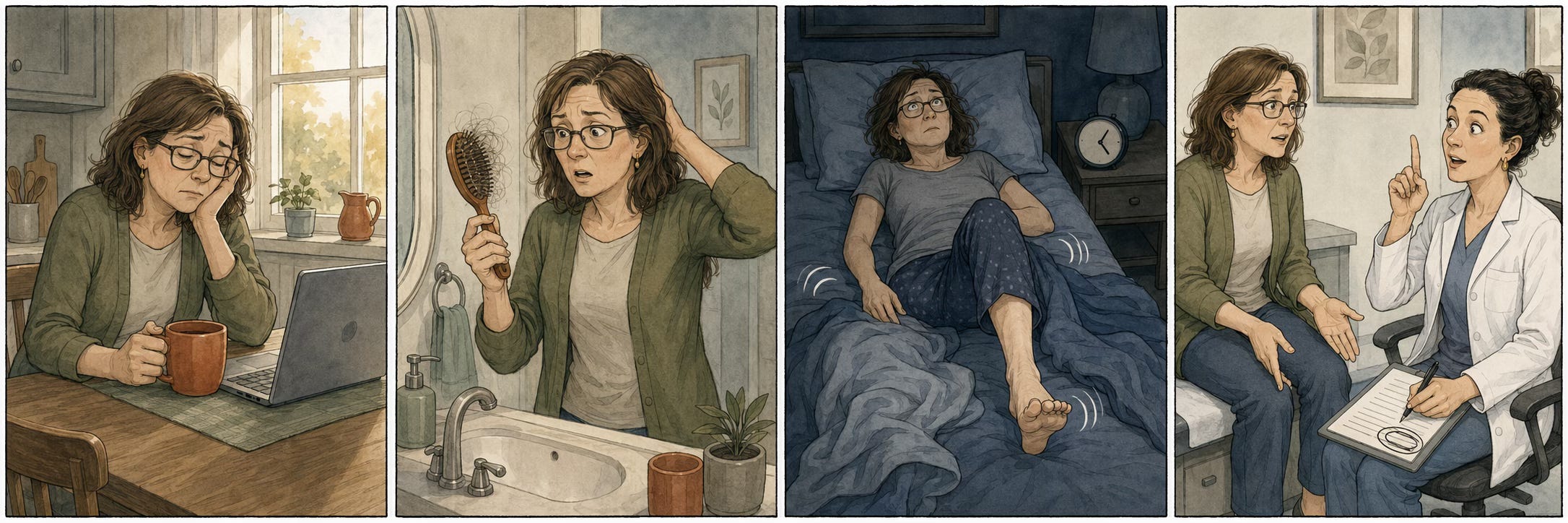
She is forty-nine and she has been tired since her daughter’s junior year. Not the kind of tired a full night of sleep fixes. The stairs feel steeper, and by mid-afternoon she is reading the same paragraph three times before it sticks. Her hair has been coming out in the shower, enough that she notices it in the drain. Some nights her legs will not settle until well after midnight. She walks the same loop she has walked for six years and her heart rate climbs higher than it should.
So she asked her doctor for bloodwork. Everything came back normal. Hemoglobin fine, thyroid fine. She was told to work on her sleep and come back in a year.
If you have done that and gone home with nothing, this is about the part of the panel that was probably never ordered. I am not talking about thyroid disease, and not perimenopause. This is one gap between what a standard panel measures and what your body runs on.
The shelf is faced
Walk into a grocery store near closing time and look at a shelf of canned tomatoes. It reads as full. Every can sits flush at the front edge, label forward.
Now slide the front can back. It travels the whole depth of the shelf without hitting anything. One can deep, all the way across.
Retail workers call this facing. At the end of every shift, staff pull whatever remains forward to the lip of the shelf so the store looks well stocked. The more aggressive version is called front filling, where whatever stock is left gets spaced out evenly along the shelf rather than sitting together in one group, so that no bare stretch gives the shortage away. The shelf is not lying to you, exactly. It is showing you the final row, arranged to look like plenty.
What matters is the reorder point. A stockroom keeps its own count, and someone decides how far it can fall before an order goes out. Set that number close to zero and the shelf looks full right up to the morning it is empty. That is the morning a shortage becomes a crisis instead of a warning.
Your body keeps two counts as well.
What a blood count actually counts
When a doctor checks whether you are low on iron, the test that runs by default is a complete blood count. It measures hemoglobin, the iron-carrying protein packed into your red blood cells. Low hemoglobin means anemia, and anemia is the last stop. It is the front row running out.
It happens in a set order. Storage iron drains first, mostly out of your liver and bone marrow, and a separate blood test called ferritin tracks that storage. Next, your marrow keeps turning out red blood cells but no longer has enough iron to finish them properly, so they start coming out smaller and paler than they should be. Only after that does hemoglobin fall far enough to register as anemia.
In one study of women with heavy periods, more than half had reduced iron stores while only a quarter were anemic. The rest would have sailed through a blood count without a flag.
Iron is not just for blood
Symptoms arrive before anemia because iron does far more than ferry oxygen.
Skeletal muscle holds ten to fifteen percent of your total body iron. Inside muscle, iron sits at the center of the electron transport chain, the final assembly line where oxygen and fuel become usable energy. Several of the proteins that hand electrons down that line are built around iron atoms. Take the iron away and the line slows. Your muscles produce less energy from the same delivered oxygen.
This is why the shortage shows up as a heart rate. When those pathways run poorly, your body compensates by moving more blood. Same walk, same hill, and your pulse runs higher to push more oxygen toward muscles that have gotten worse at using it. You have not lost fitness, but instead you have lost the part inside the muscle that turns oxygen into work.
Hair follicles sit in a similar position. They are among the fastest-dividing tissues you own, which makes them expensive to run and early to be cut off when supply tightens.
The same shortage reaches your brain. Dopamine, the signal that settles your legs at night, is built by an enzyme that needs iron to work, and restless legs run five to six times more common in people whose iron has fallen far enough to cause anemia. In a trial comparing oral iron against intravenous iron, both improved the symptom markedly.
Your hemoglobin, meanwhile, holds inside the normal range. It drifts down, but it has to fall a long way before it trips a flag, so it keeps reading normal while everything behind it thins out. The shelf stays faced.
The number was set to answer a different question
Ferritin has a threshold, and most laboratories flag a result as low somewhere between 15 and 30 micrograms per liter. Under 15 means storage iron is gone. Under 30 generally means stores are low.
Where did 15 come from? It was set by expert consensus decades ago, and the global health authority that maintains it has since acknowledged there was never enough data to revise it. It was built to find people whose stores were already gone, not to tell you when your body starts struggling.
Two studies looked for that answer. The first analyzed national survey data on thousands of American women, looking for the ferritin level at which red cells first show strain. Two independent markers both landed around 25 micrograms per liter. Roughly ten points above the level that triggers a flag, your marrow is already working with less than it wants.
The second looked at an earlier stage still. Researchers pooled more than a thousand measurements of how much iron women absorbed from labeled meals, then asked when the body starts turning absorption up. When stores are comfortable, absorption sits flat. Below a certain point, the body begins pulling harder on every meal that passes through. That inflection landed at 51 micrograms per liter.
Check that against your own lab report. At a ferritin of 40, your body has already registered a shortage and started compensating, and your report will still say normal, because 40 clears 15 with room to spare. That gap is roughly threefold, and the whole of it is where the tired women live.
What the trials show
Pooled results from randomized trials in women who are iron-deficient but not anemic show a real reduction in fatigue when iron is replaced. A separate pooled analysis in women of reproductive age found that iron raised maximum oxygen uptake and lowered the heart rate needed to do a fixed amount of work by about four beats per minute, though both gains showed up only in trained women however.
In that fatigue analysis, the improvement women reported was not matched by objective performance tests, which points to iron shortage changing how hard effort feels before it degrades what you can produce.
For hair, the evidence is association rather than proof. Pooling eighteen studies that compared women with and without hair loss, those with non-scarring hair loss carried ferritin levels averaging about 18 points lower.
Back to the woman on the stairs
Her hemoglobin was normal, so nobody looked further, and the number that would have explained four years of her life was never ordered.
Her heart rate on that walking loop may not have been deconditioning. It was her muscles short of the iron that pathway runs on, asking her circulation to make up the difference. The hair in the drain was a fast-dividing tissue getting rationed, and the legs that would not settle were the same shortage reaching her brain.
Unlike her age or the demands on her time, iron can be fixed, in weeks to months, with a cheap test and a cheaper treatment.
Below you will find the low iron protocol. The four tests to request on a single draw and why ferritin alone misleads in both directions, how to compare your number against three thresholds instead of one, the morning routine that quadruples how much iron you get out of the same tablet, the dosing schedule that works better with far less stomach trouble, and the point at which you should stop. You also get the printable one-page protocol and tracking sheet.
Upgrade now to access.
