

Is Your Thyroid Medication Enough? A Physician With Hashimoto’s Explains What’s Missing.
The autoimmune disease that affects 1 in 13 adults, runs in families, and responds to the same logic marine biologists use to save a reef

Before we dive in, a quick announcement. Chef Martin Oswald and I are hosting a free live cooking webinar. You'll be cooking the Cardiovascular Super Bowl right alongside Martin. When you register, you'll get the recipe and shopping list ahead of time so you can shop and prep before we go live. And this is just the beginning. We're launching a series of free monthly webinars, alternating between cooking live with Martin and sessions where I'll be teaching on a topic and answering your questions in real time. Subscribe so you don't miss any of the fun!
I was twenty-five years old and a few months past the birth of my second child, Jonathan, when I got the diagnosis. I’d been tired in a way I couldn’t explain away. I was a stay-at-home mom with two kids and a military spouse. Tired was supposed to be the default. But this was different. It was thick and heavy and it sat behind my eyes even after a full night’s sleep.
The diagnosis was Hashimoto’s thyroiditis.
My immune system had decided that my thyroid gland was a foreign invader. Cells that exist to protect me were destroying the organ that controls my energy, my metabolism, my body temperature, and the speed at which my brain works.
Then came the second shock. Jonathan, only days old, flagged on his newborn screening for thyroid problems. For two weeks my husband and I waited. At the follow-up, his levels had cleared. The doctors told us it was transient. The science behind it, which I would learn later, has to do with maternal antibodies that can cross the placenta and temporarily affect the baby’s thyroid before they clear from his system.
Twenty-eight years later, Jonathan was diagnosed with hypothyroidism himself.
Three of you asked about Hashimoto’s in Friday’s Ask Me Anything. About what causes it, whether it can be managed, and what lifestyle changes actually move the needle on thyroid antibodies. This article is my answer.
The framework that made sense of all of it came from marine biology.
A Reef Nobody Watches
Marine biologists spent decades trying to understand why coral reefs die. They assumed something was killing the coral, whether a predator, a disease, or a toxin in the water.
They were wrong. The coral wasn’t being attacked by an outside force. The ocean around it was changing. Water temperatures rose and acidity increased. The symbiotic algae that lived inside the coral and fed it through photosynthesis began to leave. Without those algae, the coral lost its food source, turned white, and starved to death in place.
They called it bleaching. And the most important thing scientists discovered about bleaching is that you cannot fix it by treating the coral. You have to fix the ocean.
That is what happens in Hashimoto’s, and it explains why the lifestyle interventions with the best evidence don’t target the thyroid at all.
The Most Common Autoimmune Disease
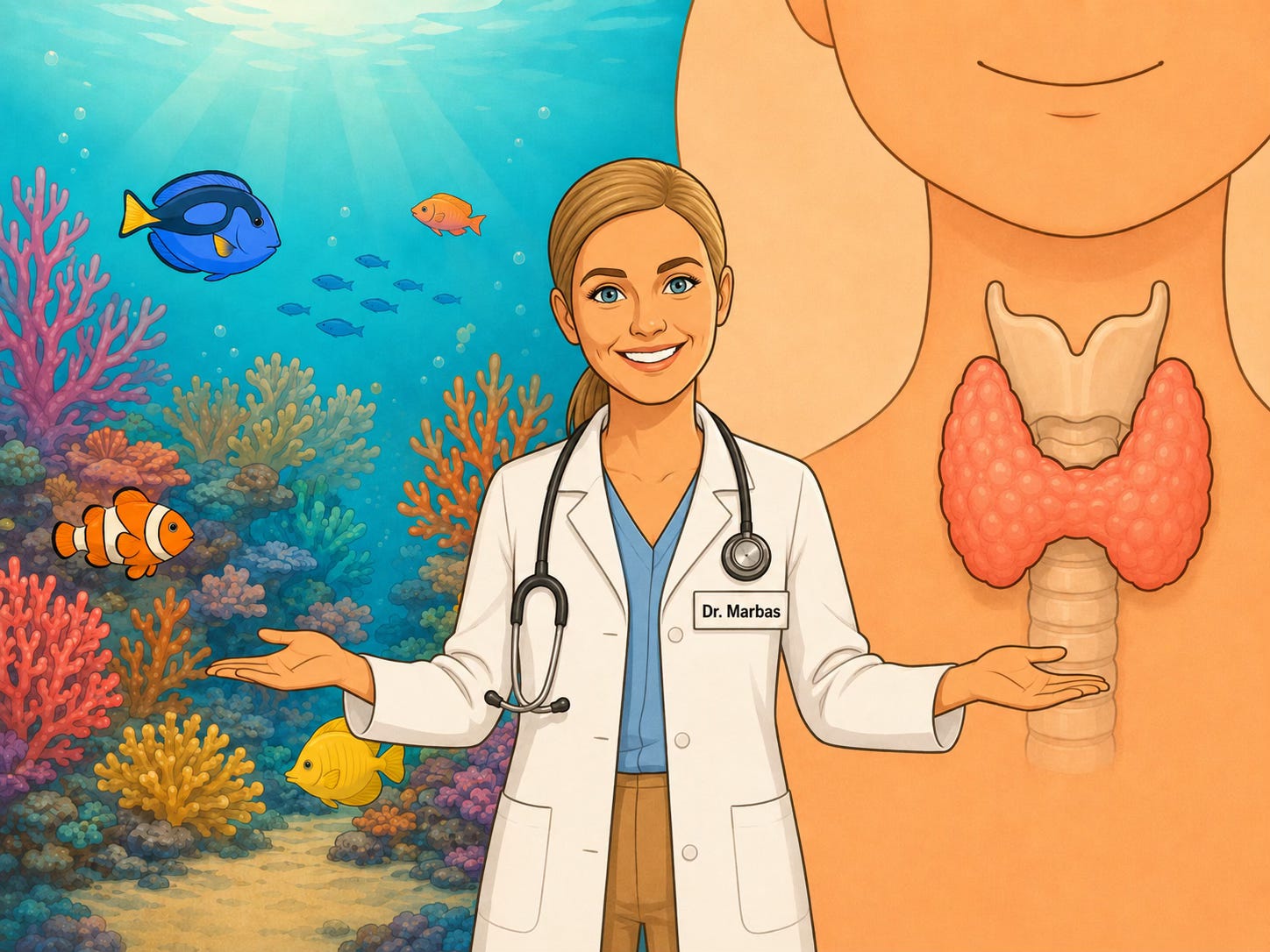
Your thyroid is a small, butterfly-shaped gland at the base of your neck. It produces hormones that regulate how fast your heart beats, how quickly you burn calories, how well your brain processes information, and how your body handles temperature. When the thyroid works properly, you don’t think about it. When it fails, you feel it everywhere.
Hashimoto’s is widely considered the most common autoimmune disease in the world. The largest meta-analysis of global prevalence data found that about 7.5% of adults have it. That is roughly one in thirteen people. Women are affected about four times as often as men, though men and every age group are represented too. This is neither rare nor niche.
And yet most people diagnosed with Hashimoto’s receive a prescription for levothyroxine and very little else. The gland is failing, so here are the replacement hormones, and we’ll see you in six months for a blood draw.
That approach is necessary but incomplete. It replaces what the damaged gland can no longer produce. It does nothing to address why the immune system is destroying the gland.
What Bleaching Looks Like on the Inside
In a healthy immune system, surveillance cells distinguish between “self” and “threat.” They identify foreign invaders like bacteria and viruses, mount an attack, and leave the body’s own tissues alone.
In Hashimoto’s, that distinction breaks down. Antigen-presenting cells begin to flag thyroid tissue as foreign. T lymphocytes, the immune system’s infantry, infiltrate the gland. B cells manufacture antibodies against thyroid peroxidase, the enzyme the gland uses to produce hormones. The result is slow, progressive destruction. Healthy thyroid tissue is replaced, bit by bit, by lymphocyte clusters and scar tissue.
The parallels to coral bleaching are almost eerie. In a healthy reef, the coral and its algae live in symbiosis. In Hashimoto’s, the thyroid and the immune system are supposed to coexist in balance. The regulatory T cells, which function as the ecosystem’s apex predators, normally keep autoreactive immune cells in check, preventing them from attacking the body’s own tissues.
When those regulators fail, the immune system turns on the gland the way a warming ocean turns on the coral. The thyroid isn’t fighting its own cells. The environment around it has shifted.
And this process isn’t sudden. It unfolds over years, sometimes decades, and understanding what happens requires a quick look at how the thyroid talks to the brain.
Your pituitary gland, a pea-sized structure at the base of your brain, constantly monitors how much thyroid hormone is circulating in your blood. When levels are adequate, the pituitary stays quiet. When they dip, the pituitary releases more TSH (thyroid-stimulating hormone), which is essentially a chemical message telling the thyroid to work harder. Once the thyroid responds and hormone levels rise, the pituitary backs off and TSH drops again. This is the negative feedback loop, and in a healthy system, it keeps everything in a tight, self-correcting range.
In Hashimoto’s, the loop starts to strain. The first sign is often invisible. Antibodies appear in the blood, but thyroid function is still normal and TSH is in range. The reef is stressed but still alive.
Then, as immune cells destroy more thyroid tissue, the gland begins losing its ability to keep up with demand. The pituitary senses the dip and raises TSH, shouting louder and louder at a gland that is losing the capacity to respond. For a while, the thyroid manages. Free T4, the actual hormone the gland produces, stays in the normal range. But TSH is already climbing. This is subclinical hypothyroidism. The reef is visibly bleaching, even though it hasn’t collapsed yet.
Eventually the gland can’t compensate no matter how loudly the pituitary signals. Free T4 drops. The symptoms that follow are the ones most people associate with thyroid disease, including fatigue, weight gain, brain fog, cold sensitivity, and thinning hair. This is overt hypothyroidism, and by this point, the functional tissue is largely gone.
The Postpartum Temperature Spike
If Hashimoto’s is a bleaching event, pregnancy is a period of artificially cooler water. During pregnancy, the immune system suppresses itself to protect the fetus. Thyroid antibody levels actually fall, and the reef stabilizes.
After delivery, the immune system rebounds hard.
In a susceptible woman, this rebound can unmask or amplify autoimmune thyroid disease. The result is postpartum thyroiditis, an aggravation of underlying autoimmune thyroiditis that the immunosuppression of pregnancy had been holding in check. A clinical review analyzing data from prospective studies across multiple countries found that postpartum thyroiditis affects roughly one in twenty women after delivery. Among women who are TPO-antibody-positive in the first trimester, up to half will develop it. And 20 to 40 percent of those cases progress to permanent hypothyroidism over the following years.
That is what happened to me. My immune system had been antibody-positive, probably for years, without my knowing. Pregnancy suppressed the attack, and delivery triggered the rebound. The postpartum temperature spike bleached a reef that was already running on thin margins.
The Reef Next Door
When Jonathan was diagnosed with hypothyroidism at twenty-eight, the mother in me felt like I’d failed him. The physician in me knew the odds had been stacked from the start.
The largest population-based study of familial Hashimoto’s risk ever conducted in Asia found that having a mother with Hashimoto’s raises a child’s risk more than fivefold. Having an affected sibling increases it nearly eightfold. Among twins, the risk climbs over a hundredfold. The study also found that familial risk was higher in younger age groups, suggesting that genetic factors play a prominent role. A separate, more recent study from a large Western genealogical database confirmed the gradient, finding elevated risk extending to second- and even third-degree relatives.
Some reefs are built on geology that makes them more vulnerable. The coral didn’t choose its substrate. Neither did Jonathan. But knowing you’re on vulnerable ground is the first step to managing conditions before a bleaching event hits.
You Cannot Fix Coral by Treating Coral
Marine biologists learned, through painful trial and error, that transplanting healthy coral into degraded water doesn’t work. The transplant dies too. The problem was never the coral. It was the temperature of the water, the chemistry of the sediment, the absence of the fish and microorganisms that kept the reef ecosystem functional.
In Hashimoto’s, levothyroxine replaces the missing hormones. It is necessary. But it does not change the immune environment driving the ongoing destruction. Every evidence-based lifestyle intervention for Hashimoto’s works on the ocean conditions, not the coral.
Once you see that distinction, you see the disease differently.
What comes next is the protocol.
Five ocean conditions you can actually change, starting with the nutrients that have the strongest trial data. The specific doses and thresholds from the largest randomized trials. A gut-thyroid connection most doctors don’t discuss. Red flags that mean it is time to change the plan. And a printable Hashimoto’s worksheet designed for your next doctor’s appointment.
Upgrade now to access.
