


You do it about twelve times an hour. Right now, as you read this, your brain is counting down to the next one. You won’t notice when it happens. You never do.
It starts with a normal-looking inhale through your nose, and then, before you exhale, you take a second, shorter inhale on top of the first. The breath ends up roughly double the size of a normal one. Then you let it all go in one long exhale. The whole thing takes a few seconds. You’ve been doing it since birth.
Physiologists call it a sigh.
For a long time, sighing was considered a footnote in respiratory science. Breathing researchers focused on the inhale, the exhale, and the rate at which they cycle. A sigh was just a bigger breath. Except it isn’t. And understanding why changes the way you think about stress, your nervous system, and what it actually takes to calm down.
It takes three words: sip, sip, sigh.
Your Brain Has a Sigh Button
Neuroscientists have identified a cluster of roughly 200 neurons in the brainstem whose sole job is to generate sighs. The most detailed mapping of this circuit comes from animal research, but the breathing architecture is shared across mammals. These neurons sit in a region called the retrotrapezoid nucleus and send signals to the preBötzinger complex, which is the brain’s central rhythm generator for breathing. When those neurons fire, a normal breath gets converted into a sigh. When they’re silenced, sighing stops entirely, but regular breathing continues unaffected.
That distinction matters. A sigh is not just a deep breath. It is a biologically separate respiratory event, produced by its own dedicated neural circuit. Your brain has one set of instructions for normal breathing and a completely different set for sighing.
So why does the brain bother? The answer has to do with the hundreds of millions of tiny air sacs in your lungs, called alveoli. Over the course of normal breathing, some of those sacs gradually collapse, like a balloon that deflates and sticks to itself. A sigh delivers about twice the air volume of a regular breath, and that extra volume pops those collapsed sacs back open. Without periodic sighing, gas exchange degrades and your body starts struggling to get enough oxygen. Sighing is maintenance. It keeps the system running.
But the sigh does something else, too. And this is where it gets relevant for anyone who has ever lain awake at 2 a.m. wondering why their brain won’t stop.
The Long Exhale Is the Active Ingredient
There’s a well-established phenomenon in cardiopulmonary physiology called respiratory sinus arrhythmia. When you inhale, your heart rate speeds up slightly. When you exhale, it slows down. This happens because inhalation temporarily suppresses your vagus nerve, which is the main communication line between your brain and your parasympathetic nervous system (the “rest and digest” branch). Exhalation restores vagal activity and shifts your body back toward calm.
Every single breath you take is a tiny toggle between activation and recovery. Inhale pushes you a fraction toward “go.” Exhale pulls you a fraction toward “stop.” The ratio between the two determines which side wins.
Research on slow breathing consistently supports this. A systematic review found that when people breathe at about six breaths per minute with a longer exhale than inhale, parasympathetic activity increases significantly. The people in those studies also reported feeling more pleasant and showed lower physiological arousal compared to people breathing with the same rate but a longer inhale. Same number of breaths. Same total air. The only difference was how the time was divided between inhaling and exhaling.
This is what makes the physiological sigh so effective. It has a short, compressed inhale phase (two quick sips of air) and a long, slow exhale. By design, it maximizes the time your nervous system spends in the parasympathetic zone. You’re not just breathing more slowly. You’re structurally tilting each breath toward the calming half of the cycle.
What Happens When You Do It on Purpose
Your body generates sighs involuntarily. But what happens when you perform them deliberately, on a schedule, as a daily practice?
A randomized controlled trial tested exactly this. Researchers recruited over a hundred participants and randomly assigned them to one of four groups. The first group practiced cyclic sighing: a double inhale through the nose followed by a long exhale through the mouth, repeated for five minutes. The second group practiced box breathing, the technique used in military training, where inhales, exhales, and breath holds are all equal in duration. The third group practiced a hyperventilation-based approach with rapid breaths followed by a breath hold. The fourth group practiced mindfulness meditation, sitting quietly and observing their breathing without trying to control it. Every group did their assigned practice for five minutes a day, every day, for four weeks.
The cyclic sighing group showed a significantly greater improvement in positive mood compared to the mindfulness meditation group. They also showed a significantly greater reduction in resting respiratory rate, and this reduction was measured during sleep and rest periods, not during the breathing exercise itself. Their baseline physiology was shifting. The benefit also grew with practice. The more days participants completed, the larger the improvement, suggesting that consistent practice produces a cumulative effect rather than just a momentary reset.
All four groups improved on daily mood measures, and breathwork as a pooled category outperformed the mindfulness condition on positive affect. But when you look at the individual breathwork styles, cyclic sighing is the one that clearly separated from mindfulness on both positive affect and respiratory rate.
One honest caveat: the study was not large enough to make direct statistical comparisons between the three breathwork groups. So while cyclic sighing showed the strongest overall pattern of results, claiming that it is definitively “better” than box breathing or other methods would be overstepping what the data actually show. What the evidence does support is that cyclic sighing produced the most robust results when compared to mindfulness, which is itself a well-studied intervention.
A Broader Look at the Evidence
That trial doesn’t exist in isolation. A large meta-analysis of randomized controlled trials found that structured breathing interventions produced a significant reduction in self-reported stress, with additional significant effects on anxiety and depression. Across the included trials, adverse events were rarely reported, and where safety was tracked, slow-paced breathwork appeared generally well tolerated.
The effect sizes were modest, which sounds discouraging until you consider what we’re talking about: five minutes, no equipment, no cost, no prescription. When the barrier to entry is essentially zero, even a modest effect becomes clinically meaningful because there’s nothing working against it.
The Advantage of Being Over 45
Here is a finding that’s directly relevant to many of you reading this. Researchers tested a single five-minute session of deep, slow, exhale-dominant breathing in two groups: younger adults and older adults. Both groups showed a significant increase in parasympathetic nervous system activity and a significant drop in anxiety after just one session. Five minutes. One time.
But the older adults showed a significantly greater parasympathetic response than the younger adults. The researchers discussed several possible explanations, including age-related changes in autonomic regulation, but the study design couldn’t establish why the difference occurred. What it does suggest is that if your nervous system has been running in a chronically activated state for years, exhale-dominant breathing has a larger physiological gap to fill. You don’t benefit less from this practice as you age. You may benefit more.
How to Do It: Sip, Sip, Sigh
The protocol is three words. If you can remember “sip, sip, sigh,” you can do this.
First sip: Breathe in through your nose, filling your lungs with a deep, steady inhale.
Second sip: Without exhaling, take one more short, sharp inhale through your nose on top of the first. Your lungs should feel fully expanded. This is the double inhale that mimics the structure of a natural sigh and reinflates collapsed alveoli.
Sigh: Now exhale slowly through your mouth until every last bit of air is gone. Make it long. Make it slow. This is the active ingredient. The extended exhale is what drives the parasympathetic shift.
That’s one cycle. Repeat for five minutes.
A few practical notes on building this into your day. You don’t need to be sitting in a quiet room. You can do this in your car before walking into the office, at your desk between meetings, or lying in bed before sleep. You don’t need to clear your mind. You don’t need to focus on a mantra or observe your thoughts. You just need to breathe in a specific pattern. Some people set a recurring timer on their phone. Others pair it with an existing habit, like right after their morning coffee or right when they get home from work.
The research suggests that consistency matters. Five minutes every day appears to produce a cumulative benefit that grows over time. If you miss a day, start again the next day. The goal is to string together as many days of practice as you can, because the physiological changes build on each other.
If you want to try it right now, do three rounds. First sip in through the nose. Second sip on top. Long sigh out. Again. One more time.
If you feel a shift, even a small one, that’s consistent with how exhale-dominant breathing patterns can influence arousal in real time. If you don’t feel much yet, that’s normal too. The research shows the effects strengthen with repetition.
This Is the Signal
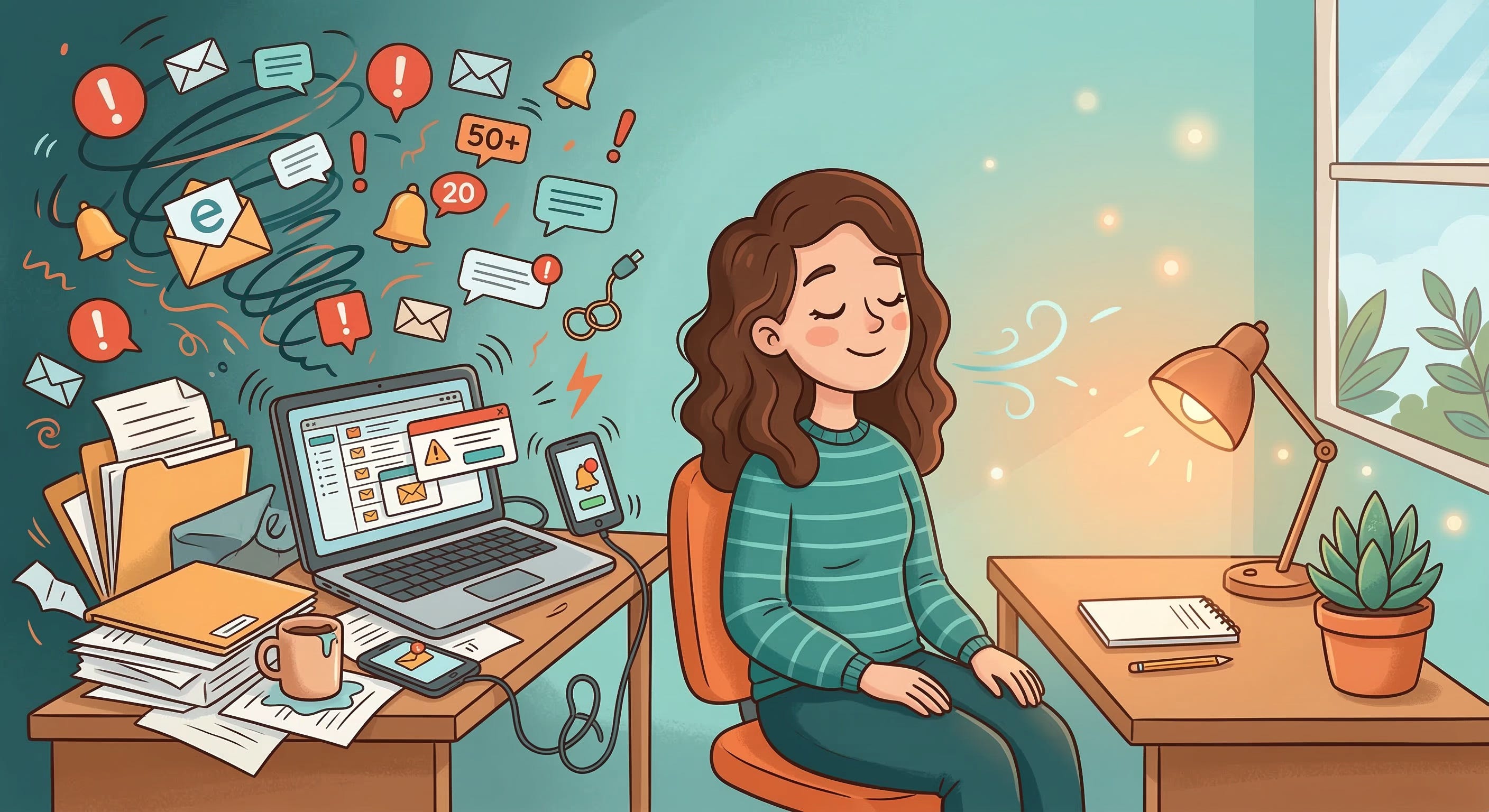
Your nervous system isn’t broken. It hasn’t forgotten how to calm down. It is waiting for specific physiological input that tells it the threat has passed and it’s safe to stand down. For many of us, that input never arrives because the stressors never fully stop. The emails keep coming. The obligations keep stacking. And the nervous system, doing its job faithfully, stays activated.
Sip, sip, sigh. That’s the signal. Five minutes a day. Free, portable, and backed by a growing body of randomized controlled evidence.
If you want to go deeper on the science of stress regulation, habit change, and the small daily practices that actually move the needle on your health, I’d love to see you inside The Habit Healers community on Skool, where Chef Martin Oswald and I coach these habits live every week. This is where the article becomes a practice and the practice becomes a lifestyle. Click here to learn more.

References
Balban MY, Neri E, Kogon MM, et al. Brief structured respiration practices enhance mood and reduce physiological arousal. Cell Rep Med. 2023;4(1):100895. doi:10.1016/j.xcrm.2022.100895
Severs LJ, Vlemincx E, Ramirez JM. The psychophysiology of the sigh: I: The sigh from the physiological perspective. Biol Psychol. 2022;170:108313. doi:10.1016/j.biopsycho.2022.108313
Zaccaro A, Piarulli A, Laurino M, et al. How Breath-Control Can Change Your Life: A Systematic Review on Psycho-Physiological Correlates of Slow Breathing. Front Hum Neurosci. 2018;12:353. Published 2018 Sep 7. doi:10.3389/fnhum.2018.00353
Magnon, V., Dutheil, F. & Vallet, G.T. Benefits from one session of deep and slow breathing on vagal tone and anxiety in young and older adults. Sci Rep 11, 19267 (2021). https://doi.org/10.1038/s41598-021-98736-9
Fincham, G.W., Strauss, C., Montero-Marin, J. et al. Effect of breathwork on stress and mental health: A meta-analysis of randomised-controlled trials. Sci Rep 13, 432 (2023). https://doi.org/10.1038/s41598-022-27247-y
Li P, Janczewski WA, Yackle K, et al. The peptidergic control circuit for sighing. Nature. 2016;530(7590):293-297. doi:10.1038/nature16964
Ashhad S, Kam K, Del Negro CA, Feldman JL. Breathing Rhythm and Pattern and Their Influence on Emotion. Annu Rev Neurosci. 2022;45:223-247. doi:10.1146/annurev-neuro-090121-014424
Years ago I read about a quick method to stop hiccups: inhale deeply, hold for a few seconds, then forcibly exhale until there’s no air left in the lungs, then hold for as long as can be tolerated, even if there is a hiccup spasm. After the quick inrush of air, the hiccups will be gone. Works every time
I tried this for five minutes, and I yawned at least five times!!!😍