


Marcus woke at 2:47 AM on a Wednesday in October with a mouthful of acid. He had done everything on the list, from cutting coffee after noon to eliminating tomato sauce, chocolate, and wine. He ate dinner at 6 PM, propped himself on two pillows, and took his omeprazole every morning before breakfast. Three months of compliance, and the reflux still dragged him out of sleep on the nights he needed it most.
He had been told the problem was acid, too much of it, triggered by the wrong foods and made worse by eating too late. The solution, according to the pamphlet his doctor handed him, was to remove the triggers, take the medication, and wait. He followed every instruction, and the burn came back anyway.
The pamphlet was wrong about the cause.
The gate that won’t stay closed
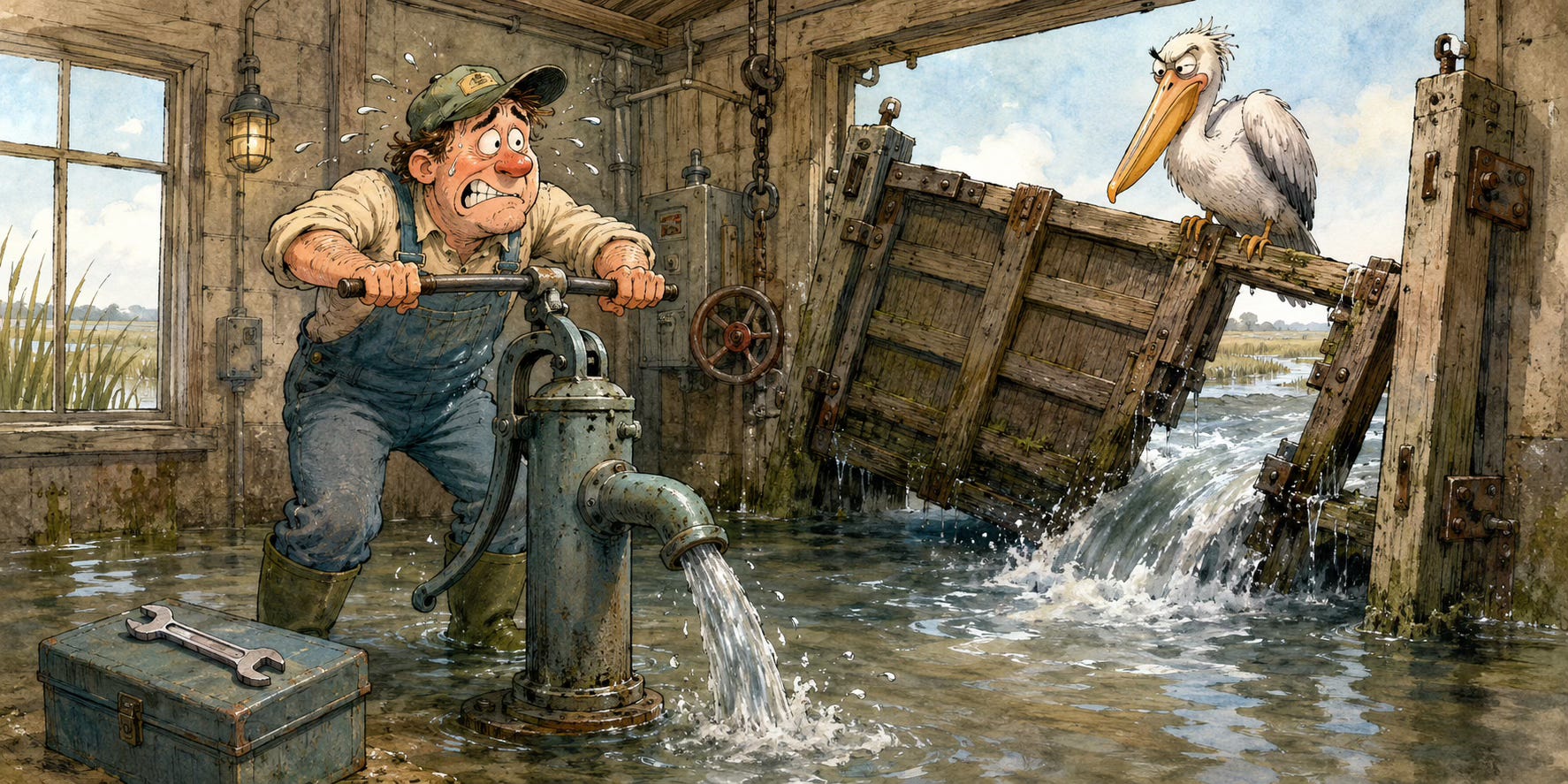
In the tidal marshes along the coast, engineers build flood gates to keep seawater from pushing inland when the tide rises. The gate sits at the boundary between salt water and fresh, and it works by responding to pressure. When the tide comes in, the gate closes. When it falls, the gate opens to let the marsh drain. The latch, the hinge, and the weight of the water all have to cooperate. When they do, the water stays where it belongs.
But when the gate mechanism fails, it doesn’t matter how much water you pump out of the marsh. The next tide brings more, and you can run the pump harder or run it all day. The marsh still floods, because the problem was never the volume of water. The problem was the gate.
Your lower esophageal sphincter works the same way, a ring of muscle at the bottom of your esophagus, three to four centimeters long, and it forms a high-pressure zone between your stomach and your throat. When it closes, acid stays down. When it opens, acid rises. In healthy digestion, the sphincter relaxes briefly when you swallow, lets food pass into the stomach, and seals again.
Reflux happens when the gate opens at the wrong time.
What opens the gate
The main driver of reflux is something called transient sphincter relaxations. The valve pops open on its own, without a swallow to trigger it, and stays open for 10 to 35 seconds. These relaxations are not caused by eating spicy meals or drinking coffee. The main trigger is the physical stretch of the stomach wall after eating. When the stomach expands with food, it sends a nerve signal that relaxes the valve.
When the sphincter relaxes, whatever is sitting at the top of the stomach enters the esophagus. And what sits at the top of the stomach after a meal is not what you would expect.
The pool at the gate
In 2001, a group of researchers in Glasgow noticed something odd in their pH data. They were recording stomach and esophagus pH over twenty-four hours in patients being investigated for indigestion, and they saw something that didn’t make sense.
After a meal, the food in the stomach neutralizes most of the acid. The acidity of the main stomach chamber drops dramatically, from a pH of 1.4 (very acidic) to above 4.7 (much closer to neutral). That is why ulcer pain gets better after eating. Food makes the stomach less acidic.
But the fluid splashing up into the esophagus after meals was more acidic than the stomach contents it came from. That shouldn’t happen if the stomach is one evenly mixed pool.
They followed up in healthy volunteers, using a thin acid-measuring probe that they slowly withdrew through the stomach one centimeter at a time. Under fasting conditions, the pH was uniformly low throughout the stomach and then jumped sharply as the electrode crossed into the esophagus. After a meal, the pattern changed. The buffering effect of the food was strongest in the body of the stomach and weakest at the very top, near the junction with the esophagus. There, a pocket of unneutralized, highly acidic stomach acid sat on top of the meal like oil floating on water. The pocket registered a pH of 1.6, nearly as acidic as battery acid. The main stomach chamber, six centimeters away, registered 4.7.
The researchers then clipped tiny metal markers to the exact boundary where the stomach lining meets the esophageal lining and repeated the measurements. They found that after a meal, the acid pocket did not just sit near that boundary but crossed it, extending an average of 1.8 centimeters above the boundary into the lower esophagus while the boundary itself stayed in place.
They also tested whether this would happen outside the body. They collected stomach acid from a volunteer and poured it on top of a blended fatty meal in a beaker. The acid sat on top. They stirred the mixture until it looked uniform. The acid layer reformed on top.
The reason is partly density and partly anatomy. Stomach acid is essentially acidified water, lighter than the thick slurry of digested food below it. The same physics that separates salad dressing in a jar, with the lighter liquid rising above the heavier one, keeps acid on top of the meal. Inside the stomach, two additional forces maintain the separation. MRI studies show that the fat component of a meal floats above the more watery phase. And the upper stomach, where the acid-producing cells are concentrated, is relatively still after eating. The muscular contractions that churn and mix food arise further down and move away from the top, so nothing stirs the acid back into the meal.
This is the acid pocket. It forms after meals in most people, and it sits right at the gate. When the sphincter relaxes, the first thing through is not the buffered contents of the stomach. It is the concentrated, unbuffered acid floating on top.
What makes the gate worse
The acid pocket explains why reflux is worst after meals. But two factors determine whether the pocket causes damage or passes without symptoms.
The first is body weight. Fat around the organs in your abdomen increases the pressure pushing up against the valve. More belly pressure means the valve has to hold against a stronger force, and it fails more often.
The second is body position. When you lie on your right side, the esophagus sits below the stomach, and the acid pocket drains toward the junction. When you lie on your left side, the stomach sits below the esophagus, and the acid pocket pools away from the valve.
This is why the time of day matters too. Eating close to bedtime means lying down while the acid pocket is at its largest. Your body clears acid from the esophagus far more slowly during sleep because you swallow less and produce less saliva.
Marcus’s reflux, explained
Marcus had eliminated coffee, chocolate, citrus, and tomato sauce. None of those eliminations had anything to do with his sphincter or the acid pocket sitting at the top of his stomach after every meal. He propped himself on two pillows, but the trial that showed benefit used a wedge that tilted the entire bed frame, not stacked pillows. (The two are not the same.) He took his omeprazole every morning, which reduced the amount of acid his stomach produced. But the sphincter still relaxed at the wrong times, and whatever acid remained still pooled at the junction.
His reflux was a gate problem, and he had been treating it as a water problem.
Unlike genetics, unlike a hiatal hernia (where part of the stomach pushes up through the diaphragm), unlike the speed at which his esophagus clears acid on its own, the factors that press on the gate are ones he can change. Weight. Position during sleep. Timing of meals. The composition of those meals. And, with his doctor’s involvement, the medication that was supposed to be temporary.
Next: The Valve Reset Protocol Worksheet
Below you’ll find the evidence for every intervention that targets the valve, including which ones worked in controlled trials and which ones didn’t. Then The Valve Reset Protocol, a seven-step system sequenced so each fix compounds the last. Then the medications section, covering when PPIs are warranted, how stopping cold creates a rebound that traps you on the prescription, and exactly what to say to your doctor when you want to step down. The printable worksheet puts the full protocol and the doctor conversation template on two pages.
Paid subscribers get every protocol, every worksheet, and the full archive.
Upgrade now to access.
