


You know the feeling. The kids have moved out, or you’ve finally retired, or you’ve just crossed some invisible line where the big problems are solved. The mortgage is manageable, the fridge is full, and the calendar is yours for the first time in decades. By any reasonable measure, things are good.
And yet something has shifted. You see fewer people, and the phone rings less often. Whole weeks pass where your deepest interaction is with the cashier at the grocery store. You fill the time with exercise, errands, a little online shopping. You’re taking care of yourself, and you look fine. But something essential has gone missing, and you can’t quite name it.
In 1968, a behavioral researcher, John Calhoun, working for the U.S. government built a world where nothing could go wrong.
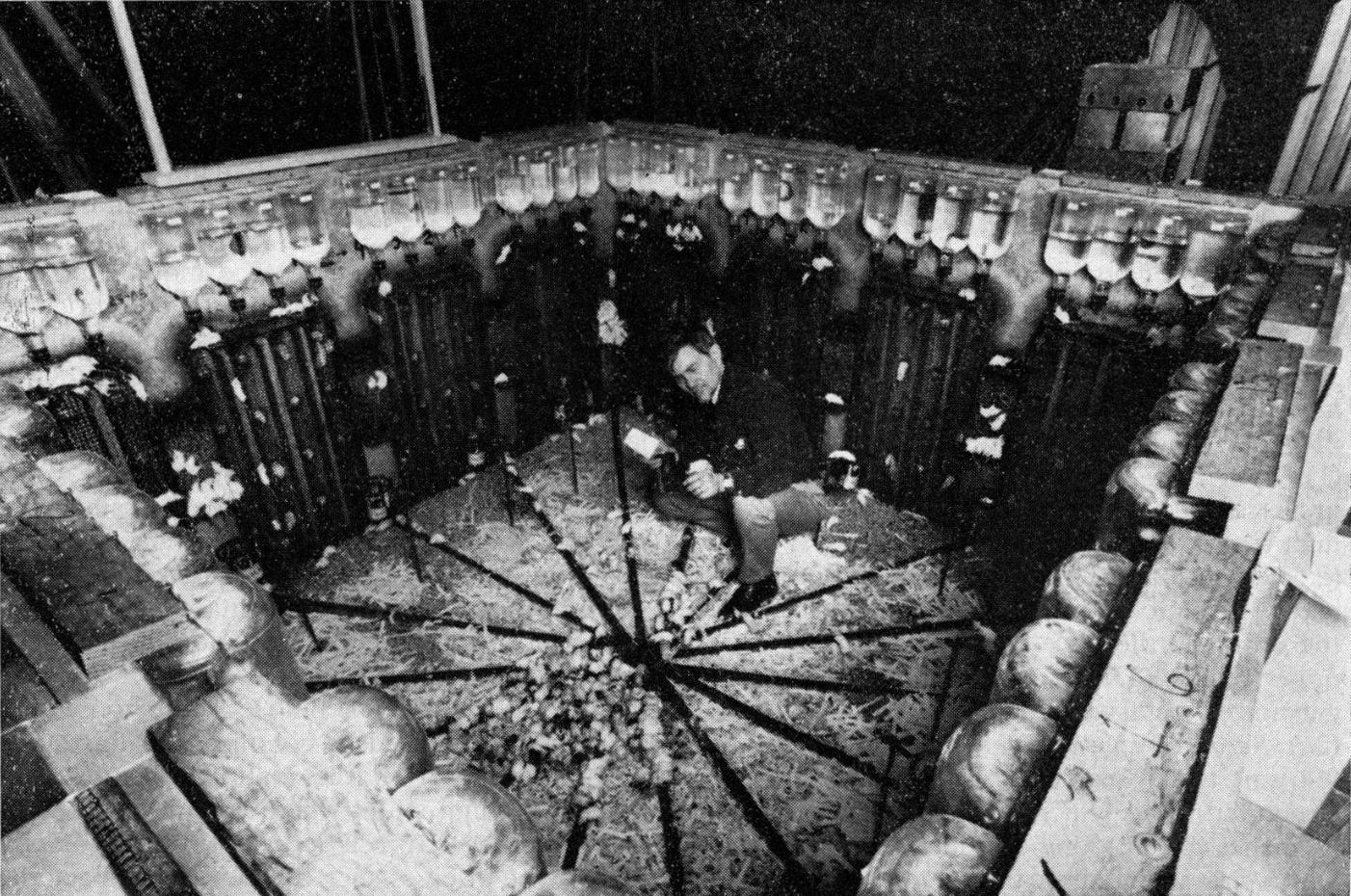
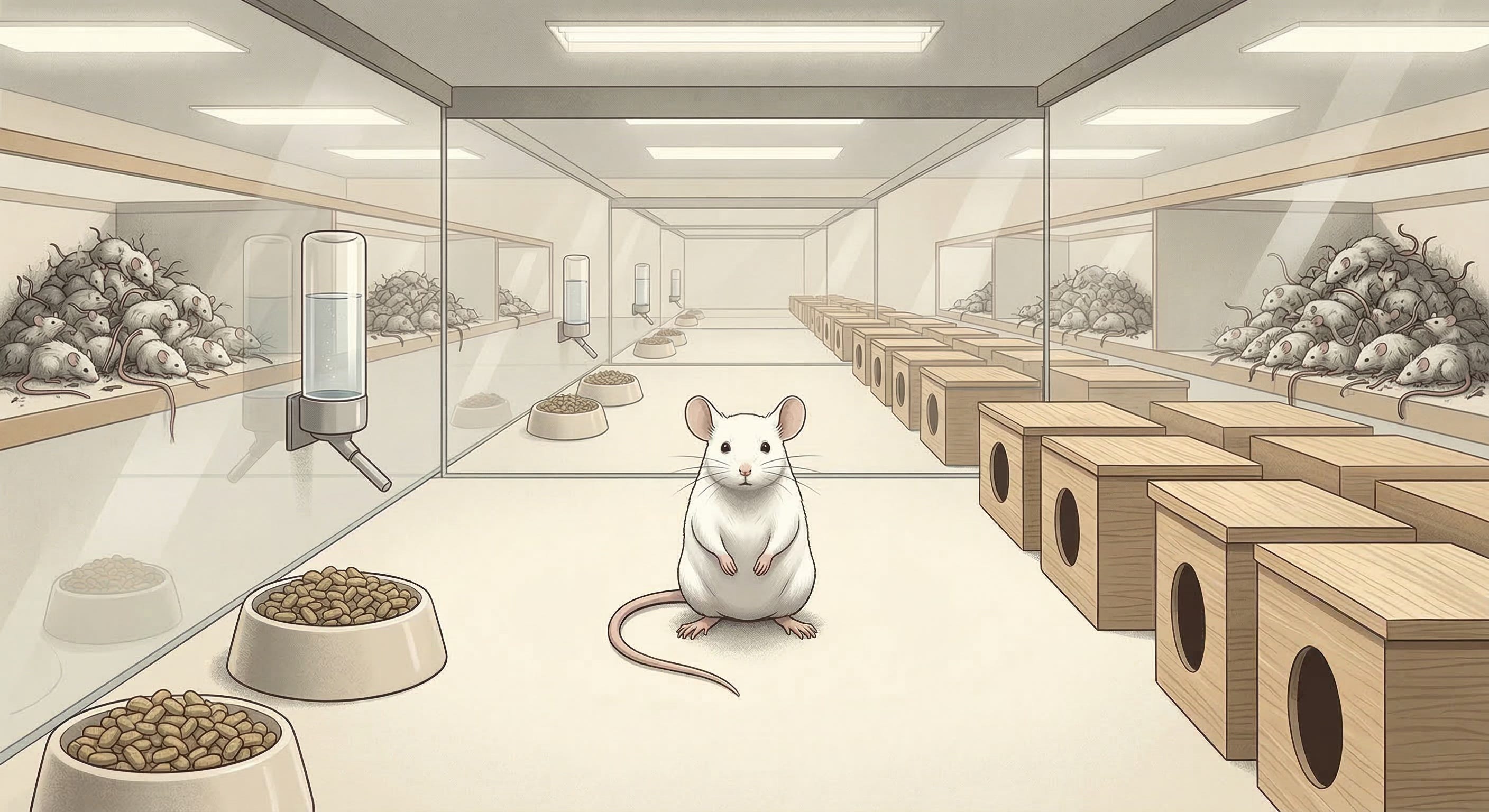
He constructed a habitat for mice, and it was designed to be a paradise. It was a square enclosure about eight feet on each side with walls over four feet high. Inside, there were 256 nesting boxes, each designed to house fifteen mice comfortably. Sixteen feeding stations could support twenty-five mice eating at the same time. Water was unlimited and the temperature was controlled. The mice were a disease-free laboratory strain, screened for pathogens, and there were no predators, no competition for food, and no harsh weather. By the numbers, food wouldn’t become scarce until the population reached 9,500 mice, while water could support more than 6,000 and shelter wouldn’t be a problem until nearly 4,000.
Four breeding pairs were placed inside on July 9, 1968. He called the experiment Universe 25.
Every material need was met. The one thing the enclosure could not provide was room in the social order for the next generation, or any way to leave and find it elsewhere. And then the colony went extinct.
The Four Phases
For the first 104 days, the eight founding mice explored and adjusted. Then the first litters were born, and the population began to grow fast. During what the researcher called Phase B, the colony doubled roughly every 55 days. Social organization worked the way it does in any healthy mouse population: males established territories, females chose mates and built nests, and pups were raised, weaned, and moved into the social system. By the time the population reached about 620, fourteen stable social groups had formed, each with a dominant male, associated females, and their young.
Then the math changed.
At 620 mice, the doubling time suddenly stretched from 55 days to 145. The colony was nowhere near its physical limits. There was still abundant food, water, and empty nesting space. Twenty percent of the nest sites remained unoccupied even as the population approached its peak of about 2,200.
The bottleneck had nothing to do with resources. Every social role was already filled.
As the unusually large number of young mice born during the boom years reached adulthood, they found no openings. The territories were taken and the social positions were occupied. And in this closed universe, there was no opportunity to leave and start over somewhere else. Males who failed to win a social role withdrew physically and psychologically, eventually aggregating in passive groups in the center of the enclosure floor, doing little except eating and sleeping. They absorbed frequent attacks from one another.
The females, meanwhile, faced a different crisis. As territorial males became exhausted from defending against waves of displaced younger males, the nest sites became vulnerable to invasion. Nursing mothers, now unprotected, became aggressive themselves. That aggression generalized to everything around them, including their own pups. Young mice were attacked and wounded, then pushed out of the nest days before normal weaning. Conception rates dropped, more pregnancies were reabsorbed before birth, and pups that were born were increasingly abandoned.
By the end of this phase, the researcher wrote, there had been “a death of societal organization.”
The Beautiful Ones
The mice born into this chaos never learned how to be mice.
Prematurely rejected by overwhelmed mothers, they entered the world without having formed normal social bonds. They grew up surrounded by conflict but never participated in it. They never competed for territory or courted a mate, and because they never fought, they never had scars, which meant their fur remained in perfect condition.
The researcher called them “the beautiful ones.”
Their behavioral range had collapsed to the bare minimum: eating, drinking, sleeping, and grooming. Nothing they did carried any social function beyond the accident of being near other bodies. They looked healthy, and physically they were in excellent shape. But they had no social capacity, no reproductive drive, and no functional role in the colony.
And their condition was permanent. In a separate experiment, a colleague took small groups of these mice and placed them into brand-new, empty enclosures at very low densities. Every advantage of the original founding conditions was restored. It made no difference. The mice “exhibited nearly total loss of capacity for developing a structured society or for engaging in the full repertoire of reproductive behaviours.” Even when paired with normal mice from uncrowded conditions, they couldn’t recover what they had never learned.
The First Death
The population stopped growing on Day 560, well before the enclosure reached anything close to capacity. A few pups were born after that, but none survived past weaning after Day 600. The last conception occurred around Day 920. By November of 1972, just over four years after the experiment began, only 27 mice remained: 23 females and 4 males, all past reproductive age. The colony was already dead. The last bodies just hadn’t caught up yet.
The researcher had a phrase for this. He borrowed it from the Book of Revelation. Physical death, the death of the body, is the second death. But before any body dies, something else dies first. The capacity to engage in the behaviors that keep a species alive: raising young, defending territory, forming bonds, participating in a social structure. He called this the first death, the death of the spirit. And his central argument was that eliminating every cause of physical death had, paradoxically, produced spiritual death. Remove every external threat, and what kills you is the collapse of internal purpose.
We Are the Mice
Universe 25 wasn’t a loneliness experiment. The mice were surrounded by other mice. The collapse came when too many adults competed for too few meaningful roles, and with no way to leave, the social system couldn’t absorb them. The parallel to modern human life isn’t overcrowding. It’s what happens when the default structures that used to assign people a place, a purpose, and a daily reason to show up are removed by retirement, relocation, bereavement, or simply the passage of time.
A French sociologist identified this pattern in 1897. He noticed that suicide rates rose not only during economic hardship but also during sudden prosperity. When external constraints dissolved, people lost their sense of place and belonging. He called this state anomie, a word that translates roughly to “without norms.” The communities with the strongest social bonds had the lowest rates, regardless of wealth.
That observation has held up remarkably well over the past century and a quarter.
Research consistently shows that social networks shrink throughout adulthood. The contraction accelerates after major life transitions like retirement, children leaving home, or the death of a spouse. It is the peripheral connections and friendships that erode first. Family ties tend to remain stable, but the wider circle of people who give daily life its texture and its demands thins steadily. Recent large national surveys of adults 45 and older have found that roughly four in ten report feeling lonely, a number that has been climbing over the past fifteen years. Men now report higher rates of loneliness than women, and some surveys have found that nearly one in five men have no close friends at all.
All of this is happening in the most materially abundant society in human history.
The parallels to Universe 25 don’t stop at isolation. Consider the human version of “the beautiful ones”: people who have disengaged from functional social roles and now spend their time exclusively on self-maintenance. They look great and they’re busy, but they contribute nothing to anyone else’s life, and no one depends on them for anything. Research on volunteering has found that the health benefits of helping others depend heavily on why you do it. We’ll come back to that.
The mice didn’t die because the food ran out. They died because nothing they did mattered.
What Happens Inside the Body
Here is where the story moves from metaphor to mechanism.
When a person becomes socially isolated or loses their sense of purpose, the body interprets this as a threat. The stress-response system, built over millions of years for acute physical danger, activates and stays activated. Cortisol, the primary stress hormone, remains elevated. The sympathetic nervous system, designed for brief bursts of fight-or-flight, drifts toward a chronic state of alert.
This does something measurable at the level of your genes.
A study of 108 community-dwelling older adults, average age 73, drew blood samples and analyzed the expression of 53 genes involved in the body’s response to adversity. When people reported higher levels of loneliness, a specific genetic pattern switched on: pro-inflammatory genes became more active, while antiviral and immune-protective genes became less active. The body was, in effect, preparing for a kind of threat that would never arrive, while leaving itself exposed to the threats that actually kill us, infections, cancer, cardiovascular disease.
But the study found something else that changes the picture completely. When the researchers accounted for a second variable, what psychologists call eudaimonic well-being (a sense of purpose and meaning in life), the loneliness effect on gene expression disappeared. Purpose didn’t just reduce the inflammatory signal; it eliminated it entirely. The statistical relationship between loneliness and harmful gene expression dropped to zero once purpose was in the model. The body’s inflammatory response to isolation, it turns out, may depend on whether the person has a reason to exist.
That finding sits at the center of a much larger body of evidence.
A meta-analysis that pooled 148 separate studies, covering more than 308,000 people, found that the strength of a person’s social relationships predicted their likelihood of survival with an effect size comparable to well-established risk factors for mortality. The researchers noted that the association held up regardless of age, sex, initial health status, or cause of death. Weak social connection was as dangerous as the risks we take most seriously in clinical medicine.
And a large study of nearly 7,000 Americans over age 50, followed over several years, found that people with the lowest sense of life purpose had more than double the mortality risk of those with the highest purpose scores. The relationship followed a clear gradient: less purpose, more death, at every step. This held after adjusting for depression, chronic illness, and socioeconomic factors. It held for cardiovascular mortality specifically. Purpose, in this data, was a survival variable.
The mice in Universe 25 were physically healthy right up until they weren’t. Their fur was clean and their weight was normal. But their social world had been dead for months.
The researcher who built Universe 25 opened his paper with a single sentence: “I shall largely speak of mice, but my thoughts are on man, on healing, on life and its evolution.”
He was describing the first death. The death of the spirit that precedes the death of the body. His mice couldn’t reverse it.
You can.
Below, the Rebuild Your Social Architecture protocol with a printable worksheet you can start using this week.
Upgrade now to access the protocol and worksheet.
