


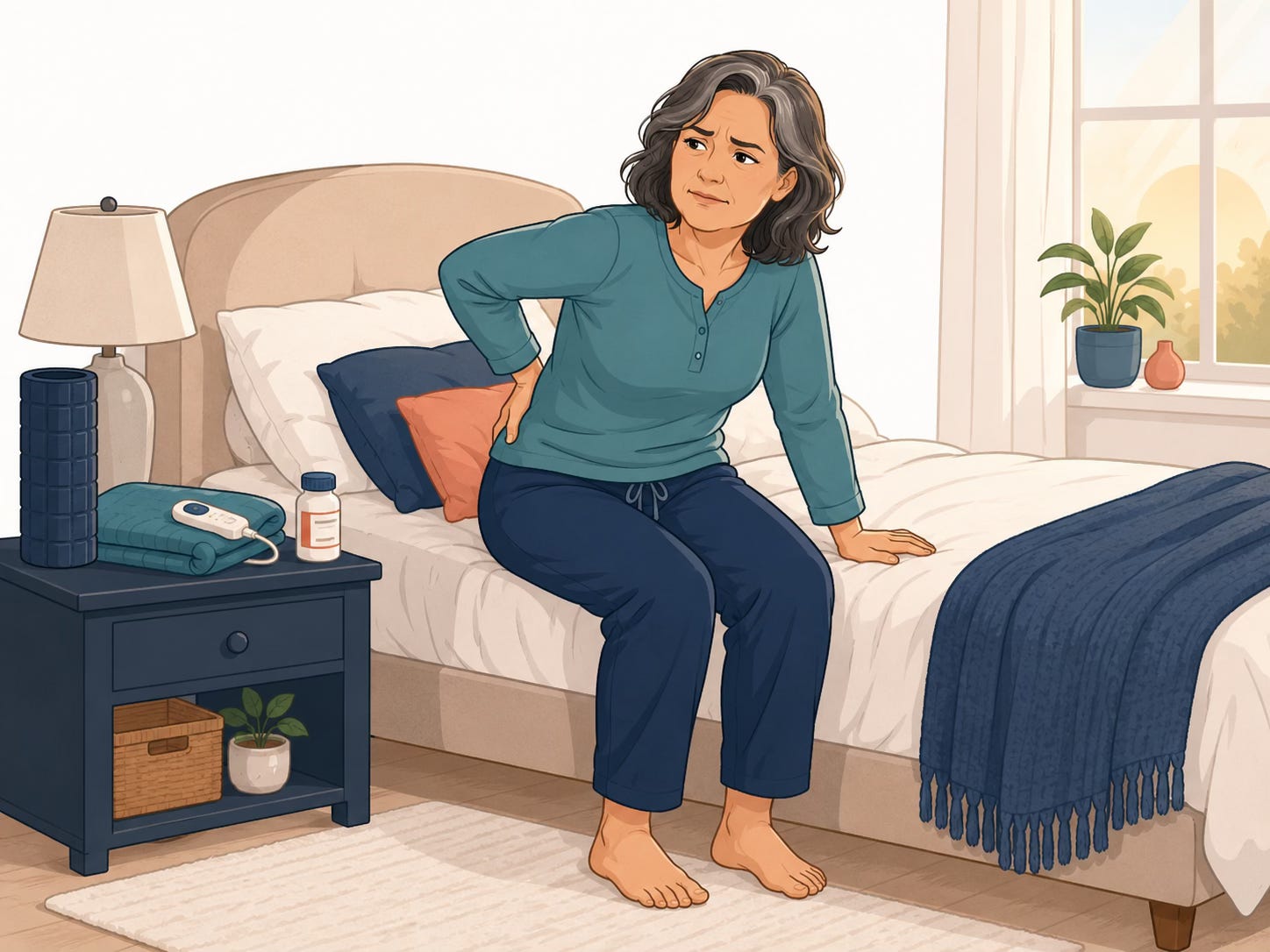
She swings her legs out of bed, and the first thing she notices is her feet. They’re stiff. Not painful exactly, but reluctant, like they need to be convinced that standing is a reasonable thing to do at 6 AM. Her low back is tight in a way that feels permanent. Her shoulders are cemented into a position that probably has something to do with how she sleeps, though changing pillows hasn’t fixed it. She shuffles to the kitchen, makes coffee, and within fifteen or twenty minutes, her body loosens up enough to function.
She’s tried stretching, foam rolling, even a massage membership for a while, and the relief lasted maybe a day and a half before everything tightened back up. Her doctor called it “normal aging.” Her physical therapist worked on her muscles and sent her home with a theraband. She’s come to accept that this is just her body now, and the acceptance sits right next to a low-grade frustration she can’t quite shake, because nobody has ever given her a satisfying answer for why this keeps happening.
If you recognize yourself in any part of that paragraph, this article is about a tissue in your body that has almost certainly never come up in a doctor’s appointment. And what I’m about to walk you through has nothing to do with energy meridians, stored trauma, or any of the unsubstantiated claims that tend to float around the fascia space online. This is about peer-reviewed research, most of it published in the last two years, that forced the medical community to rethink a tissue it had ignored for centuries.
The Ice That Moved
In the 1830s, a Swiss naturalist named Louis Agassiz drove wooden stakes into the surface of a glacier high in the Alps. He came back the following year and measured where the stakes had moved. They had moved. All of them. Downhill, in a pattern that proved the glacier was flowing like an impossibly slow river.
This sounds unremarkable now, but at the time, it upended an entire field. The dominant scientific view held that glaciers were static, inert masses of frozen water sitting on mountainsides doing nothing in particular. Most geologists treated them the way you might treat a boulder, as something that just sits there until an outside force acts on it. Agassiz and a Scottish physicist named James Forbes proved something entirely different. Glaciers have internal structure that responds to temperature and pressure, and they deform under sustained load in ways that nobody had bothered to measure before. What looked dead and rigid from the outside was, at closer inspection, a dynamic system that had been responding to its environment the entire time.
I tell you this because the same discovery happened in anatomy, except it took another 170 years for anyone to notice.
The Tissue Nobody Studied
The tissue is called fascia, and until very recently, the medical world treated it the way early geologists treated glaciers. Surgeons cut through it to reach the structures they actually cared about, the muscles, organs, and bones underneath. Anatomy textbooks described it as packing material, biological wrapping, the body’s equivalent of shipping foam. In medical school dissections, students were taught to strip it away and discard it. It was, quite literally, the tissue nobody studied because nobody thought it did anything worth studying.
The consequences of this blind spot show up constantly. A patient comes in with chronic shoulder pain that doesn’t respond to the usual treatments. Another has low back stiffness that shows up every morning and never fully clears despite years of physical therapy aimed at her muscles. Another has “knots” between her shoulder blades that come back within days of a deep tissue massage. In most cases, the muscle-focused approach helps temporarily. But the problem returns, and returns, and returns, because we’ve been treating the wrong tissue.
Over the last fifteen years, and accelerating dramatically between 2019 and 2025, a series of discoveries forced a complete reframe of what fascia actually is.
It Can Feel
The first discovery was that fascia is loaded with nerves. Research has identified it as the second most nerve-rich tissue in the body after skin, with roughly 33 nerve fibers per square centimeter in the outer fascial layer alone. Those fibers include pain sensors, pressure sensors, and fibers connected to the involuntary nervous system that controls things like blood flow and tension. This matters because it means fascia doesn’t just wrap things passively. It senses mechanical load, registers pressure, and sends pain signals.
The deeper layers of fascia are packed with pain-sensing and pressure-sensing nerve endings, with some specialized sensors (the kind that detect deep pressure and vibration) showing up in certain regions like the bottom of the foot but not in others like the abdomen. Even where those specialized sensors are missing, a vast network of thin nerve fibers pervades the tissue. This dense sensory network is in the tissue your surgeon always cut through without a second thought. Research on direct fascial stimulation has consistently found that fascia generates pain signals with characteristics distinct from muscle pain, and that pressing on areas of fascial thickening reproduces the very pain patterns (both at the spot and radiating outward) that are familiar to anyone with chronic body aches. These findings were among the evidence that pushed a major research group to formally propose that fascia should no longer be classified as a tissue type at all. In a 2025 paper, they argued that in order to properly classify fascia, it should be recognized as a full anatomical system, the way we already recognize the muscular system or the skeletal system. Four distinct fascial organs, each with its own structure and function, connected into a body-wide network that allows what researchers describe as the ability to bear tension and slide along its own layers.
That sounds technical, so let me translate. Your fascia is a layered, body-wide network of connective tissue, and those layers are designed to slide over each other. When they slide well, you feel supple. When they stop sliding, you feel stiff.
It Contains Stem Cells
The second discovery was even more unexpected. When researchers compiled evidence from 34 separate studies in 2025, spanning lab experiments, animal models, conceptual reviews, and a small number of clinical investigations, the conclusion was unambiguous. Fascia harbors multiple populations of cells that can grow, divide, and repair tissue. They are actual populations of repair-capable cells living inside your fascia, including some that direct wound healing and scar formation.
The wound healing proof was the most compelling of all. In animal models, when skin is injured, it isn’t the skin’s own repair cells that drive the initial healing response. It is the repair cells living in the fascia underneath. They migrate collectively to the wound surface, dragging their surrounding matrix with them, bringing blood vessels, nerves, and immune cells as pre-assembled repair units. If you block that fascial migration experimentally, wound repair is significantly impaired. The tissue that surgeons had been discarding as wrapping turns out to be the primary driver of wound repair.
These fascial stem cells also respond to mechanical force. They can sense how stiff or soft the tissue around them is, how the fibers are arranged, and whether they’re being stretched or compressed. In other words, how you load your body physically changes the behavior of stem cells living inside your fascia. It is also worth noting the evidence level here. Most of this stem cell research is still in animal models and lab-based studies, and the four clinical investigations in humans were small. But the convergence across 34 studies is strong enough that multiple research groups have shifted their focus to fascia as a regenerative tissue rather than a structural one.
The Lubricant That Changes State
Now we get to the part that connects all of this to the stiffness you feel every morning. Between your fascial layers sits a substance called hyaluronan. You may have heard of it because of skincare marketing, but its real job in your body has nothing to do with your face. Hyaluronan acts as a lubricant between fascial layers, and it has a property that matters enormously for how your body feels when you move. Hyaluronan in solution behaves as what physicists call a non-Newtonian fluid, which just means that its thickness changes depending on the forces acting on it. When you move, it stays thin and slippery. When you sit still, it thickens up.
When you move your body through varied ranges of motion throughout the day, hyaluronan stays fluid and slippery. The fascial layers glide over each other freely, and you feel loose. When you stop moving, or when you spend hours in the same restricted position (sitting at a desk, sleeping in one position, doing the same repetitive task), the hyaluronan thickens, its concentration between the layers increases, and the layers that should slide begin to stick together. Researchers call this fascial densification.
And this is exactly where the glacier physics apply. Glacial ice behaves in a surprisingly similar way to fascia under mechanical load. Under slow, sustained pressure, ice reshapes itself permanently and flows, with molecules rearranging themselves gradually as the glacier creeps downhill. But under sudden, rapid force, ice doesn’t flow at all. It fractures and crevasses form. The same substance responds completely differently depending on the rate and duration of the force applied to it.
Your fascia does the same thing. Slow, sustained mechanical loading allows the hyaluronan between fascial layers to return to its more fluid state, and the layers start sliding again. But quick, ballistic force (a fast bounce, a 15-second stretch, a rapid foam rolling pass) doesn’t hold the tissue long enough for it to actually reshape. The fascia barely registers it, and this is why a quick hamstring stretch before a run doesn’t fix morning stiffness. The force is too fast and too brief to change the state of the fluid between the layers.
Clinical experience and biomechanical reasoning suggest that you need sustained loading, held for roughly 90 seconds or longer, before the tissue begins to physically reshape and the sliding properties start to restore. Practitioners who work directly with fascial tissue have converged on this minimum duration, and while the exact threshold hasn’t been pinned down in controlled human studies, the principle is consistent with what we know about how fluids like hyaluronan respond to sustained versus brief force.
What This Means for Your Morning Stiffness
So here is the part that, once you understand it, changes how you think about your body.
That morning stiffness you’ve been living with? Those “knots” that never go away no matter how many massages you get? The ache in your low back that your doctor attributed to getting older?
The pain generator in many of these cases isn’t muscle, it’s the fascial layer underneath. The hyaluronan between your fascial layers has become viscous and sticky from years of limited movement variety, and the layers that should glide past each other freely are adhering instead. The sensory nerves embedded in that fascia (the ones we didn’t know about until recently) are being mechanically compressed by the densified tissue, and that compression is what triggers the pain. That’s your “knot.” That’s your stiffness.
And here is the part I really want you to hear, because so many people have accepted this as permanent decline. Unlike cartilage loss, which is genuinely difficult to reverse, and unlike bone density decline, which takes years to rebuild, this fascial stiffening responds to mechanical input relatively quickly. The hyaluronan becomes more fluid again when you apply sustained load, and the layers that stuck together can un-stick. The stiffness you’ve been calling aging has a name, a mechanism, and a solution. You are not falling apart. A specific, identifiable tissue stiffened because of how you’ve been moving (or more accurately, how you haven’t been moving), and it can un-stiffen.
The full-body fascial care protocol is below, organized by body region, with the specific types of sustained loading that the research shows actually reverses fascial stiffening and layer adhesion. I’ll also share why this matters even more after menopause, the one 90-second intervention you can try tonight, and what doesn’t work (including the truth about foam rolling). A printable copy of The Morning Stiffness Blueprint is attached.
