


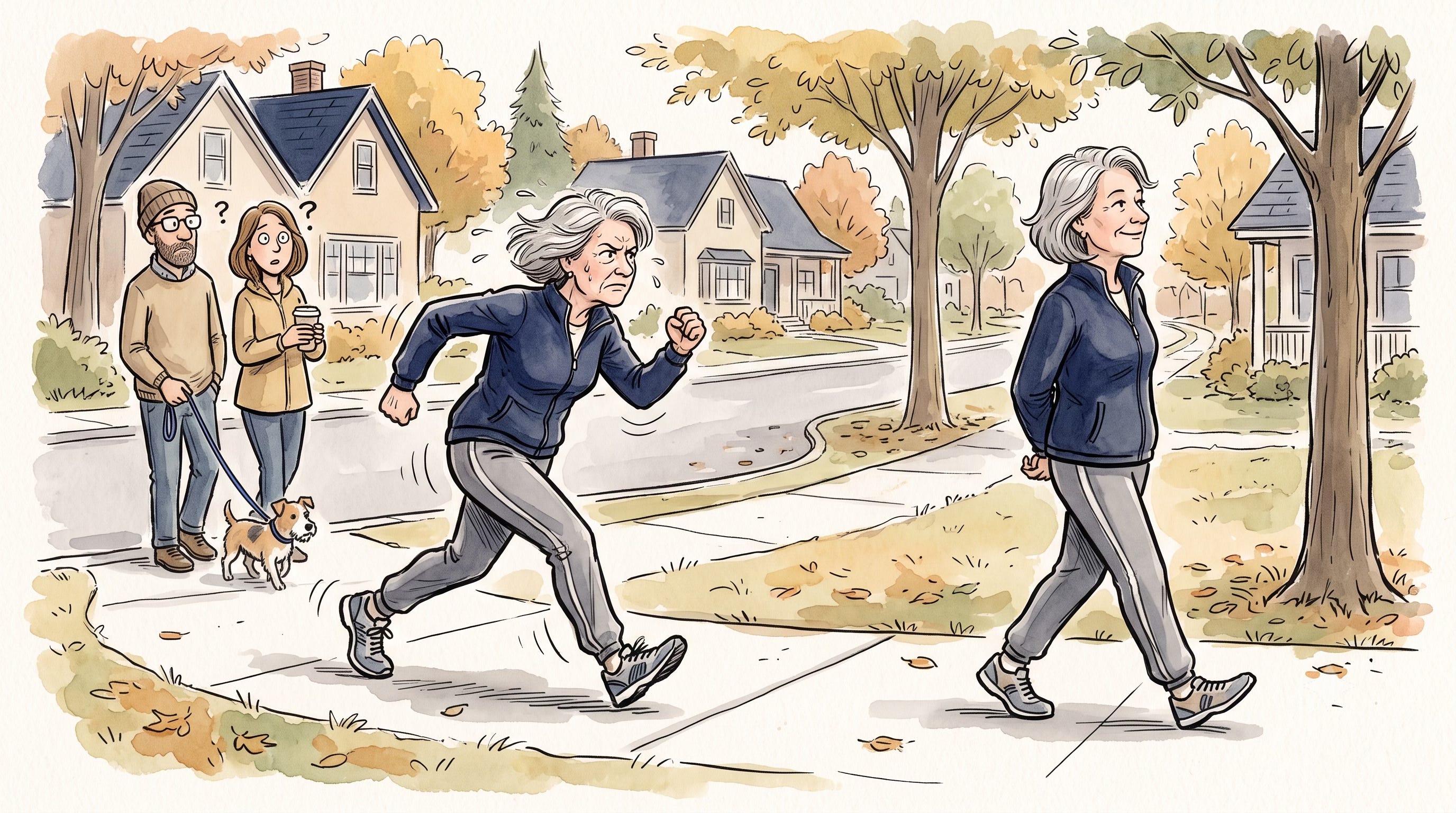
In the early 2000s, two exercise physiologists at a medical school in Matsumoto, Japan, kept running into the same disappointing data. Their city’s population was aging. Walking programs were everywhere, with pedometers were in every pocket, and the national target was 10,000 steps a day. The participation numbers looked good on paper, but when the researchers tested the people who had been walking faithfully for years, the results did not match the effort. Aerobic capacity, leg strength, and blood pressure had not budged. These were people who had done everything the guidelines asked, and their bodies had nothing to show for it.
The researchers already knew why. Comfortable-pace walking sits below the intensity threshold where the cardiovascular system is forced to adapt. It burns calories and keeps joints mobile, but it does not challenge the heart, the lungs, or the thigh muscles enough to trigger the biological remodeling that changes a lab number. The question was how to raise the intensity for people in their sixties and seventies without the injury rate, the equipment cost, and the dropout rate that come with gym-based programs. Their answer was simple enough to fit on an index card.
Walk fast for three minutes. Walk slow for three minutes. Repeat five times.
Researchers call it interval walking training. Social media calls it Japanese walking. Either way, the evidence predates the hashtag by almost twenty years.
The lesson from the practice room
When a piano teacher trains a student to play faster, she does not assign an hour at full speed. She uses a method that musicians have relied on for centuries. Play the hard passage at full tempo for four bars. Drop back to half speed for eight bars. Then repeat. The fast bars break the current ceiling by forcing the fingers into a pattern they have never sustained before. The slow bars let the new pattern consolidate. If the student plays everything at a comfortable tempo for a year, technique plateaus. If the student plays everything at full speed, the hands break down within days.
The method works because the adaptation happens during the hard bars, not the easy ones. Total practice time is irrelevant. A student who plays comfortably for two hours and a student who plays 15 minutes of hard passages inside those two hours are not doing the same thing. The second student improves. The first one stays put.
Walking works the same way.
Why your comfortable walk doesn’t change your numbers
Every cell in the cardiovascular system responds to demand. The heart thickens its walls and increases its stroke volume when it is asked to pump harder than usual. The lungs improve oxygen extraction when ventilation rises above resting levels. The quadriceps and hamstrings increase their force production when they contract against resistance they have not encountered before. All of these adaptations require a stimulus above a threshold, and comfortable-pace walking does not cross it.
The threshold sits at roughly 70% of peak aerobic capacity. For most people in midlife, that translates to a pace where conversation becomes difficult. Not impossible, but broken into short phrases instead of flowing sentences. Below that threshold, the body handles the work with its existing infrastructure. Above it, the body registers a gap between demand and capacity and begins building new infrastructure to close it.
The problem is that nobody in their sixties or seventies can sustain that intensity for 30 continuous minutes. The fatigue accumulates, the joints protest, and the session ends early or causes an injury that sidelines the next two weeks.
The three-minute interval eliminates the barrier. Three minutes is long enough to push the cardiovascular system above the adaptation threshold, and it is short enough that the fatigue does not accumulate to the point of failure. And the three-minute slow recovery that follows lets the heart rate drop, the muscles recover from the effort, and the body reset for the next bout. The total amount of high-intensity work in a 30-minute interval session is about 15 minutes, delivered in five separate doses that the body could never have sustained as one block.
Next: What the Trials Found, the Dose That Matters, and the 3-Minute Breakthrough Protocol
The mechanism explains why interval walking works. What comes next is what it delivered in the largest trials ever run on this protocol, the single variable that predicted every improvement, a blood sugar finding that overturned a decades-old assumption, and a six-week progression you can start tomorrow with no equipment.
Inside the deep-dive
The trial results on blood pressure, leg strength, and aerobic capacity, with exact numbers
The dose-response surprise that identified the one weekly metric worth tracking
The blood sugar mechanism that contradicted what exercise physiologists had assumed for decades
The 3-Minute Breakthrough Protocol with a talk-test calibration, a six-week progression, and a tracking sheet
The printable 3-Minute Breakthrough Protocol worksheet
Every Habit Healers protocol comes with a printable worksheet. The full archive of protocols, from blood sugar repair to cholesterol to pelvic floor, is available to subscribers.
Upgrade now to access.
