

There Are Only Three Steps Between You and a Stronger Body. Most People Skip the Third.
The science of why effort alone doesn't change your body, and the overlooked step that does.

*Before we get to the article, just a quick announcement. Chef Martin Oswald and I are hosting a free live cooking webinar. You’ll be cooking the Cardiovascular Super Bowl right alongside Martin. When you register, you’ll get the recipe and shopping list ahead of time so you can shop and prep before we go live. And this is just the beginning. We’re launching a series of free monthly webinars, alternating between cooking live with Martin and sessions where I’ll be teaching on a topic and answering your questions in real time. Subscribe so you don’t miss any of the fun!
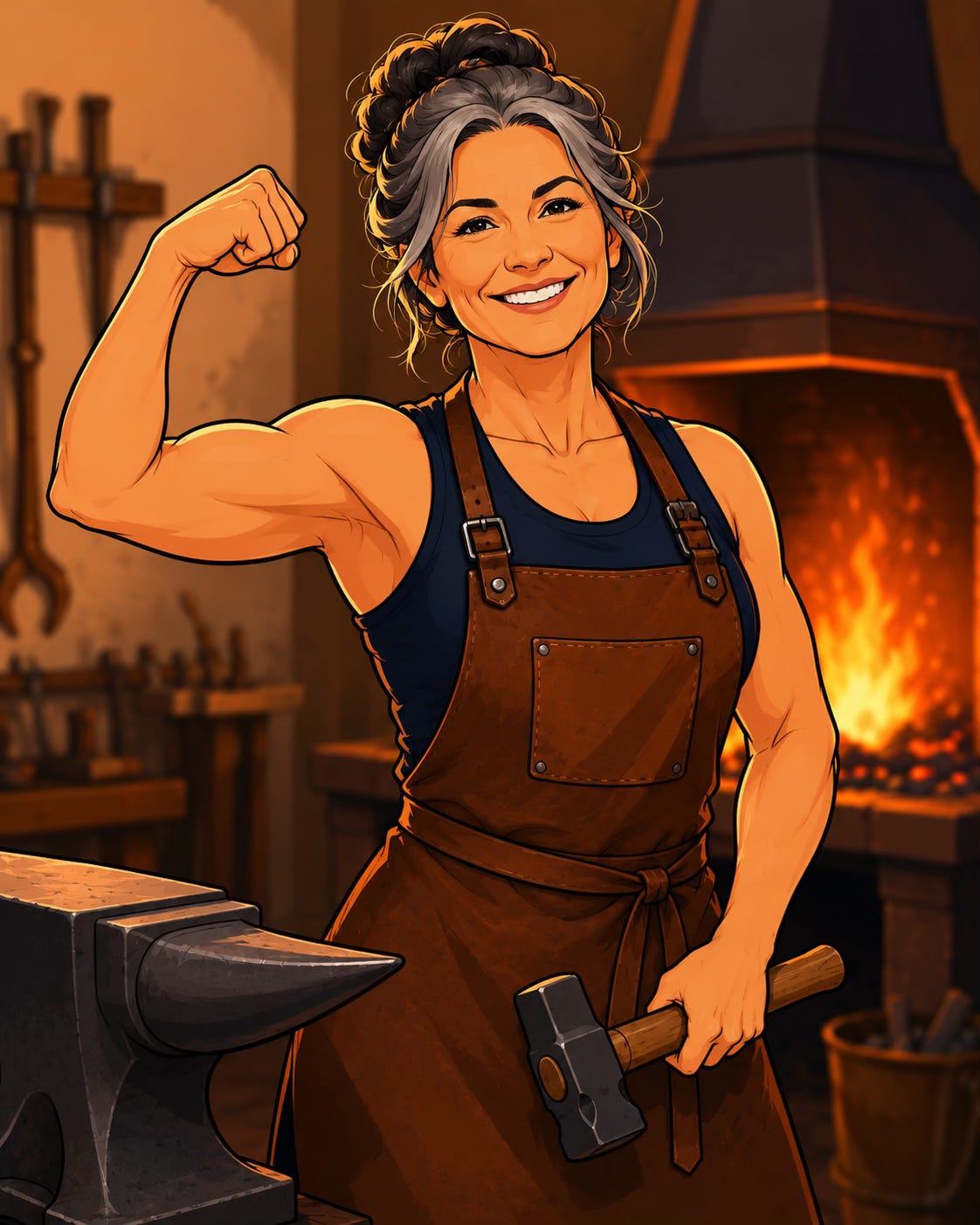
Watch a blacksmith work and you’ll notice something most people miss. The smith doesn’t just hit the metal. Before every strike, the bar goes into the forge and sits there until it glows cherry-red. Only then does it come to the anvil. The smith hammers while the steel is soft and pliable, reshaping it with each blow, and when the glow fades the hammering stops, the bar goes back into the fire, and the whole sequence starts over.
That cycle of heating, shaping, and cooling has been practiced for thousands of years, and the reason every blacksmith still follows it is that the physics hasn’t changed. Strike cold iron with a hammer and the metal resists. Rather than flowing into a new shape, it hardens and turns brittle until it cracks.
To reshape steel freely, you have to bring it to the right temperature first, work it while it’s ready, and then let it cool so the new structure can set.
Your body follows the same logic. The science of how muscles, mitochondria (your cellular power plants), and the nervous system adapt to exercise runs on the same cyclical pattern that blacksmiths figured out millennia ago. Stress the material when it’s ready, let it cool and reorganize, then do it again. Each pass leaves the structure tougher and more capable than the last.
The forge runs on three steps. The first is heat, the training signal that tells your cells to adapt. The second is the shaping, the biological remodeling your body does in response to that signal. The third is the cooling phase, the recovery period when the new structure actually sets. Most people throw everything they have at the first two and cut the third one short. That is the mistake this article is going to fix.
Skip the cycle, train without enough signal or recover without enough rest, and you’re hammering cold iron. You sweat, you ache, but the shape never changes.
You Can’t Shape Cold Metal
In materials science, the phenomenon is called work hardening. When you hammer metal that hasn’t been heated past a specific threshold (its recrystallization temperature, the point where the internal grain structure softens enough to reorganize), tiny defects called dislocations pile up inside the crystal lattice. Those defects tangle and block each other, which makes the metal stiffer with every blow. Eventually the stiffness wins and the metal fractures instead of flowing.
That is why a blacksmith never works steel that has lost its heat.
Your muscle cells have their own version of this threshold. When you push or pull against real resistance, the cells detect that mechanical tension and convert it into a chemical growth signal. That signal activates a pathway that research has shown is necessary for the muscle to adapt. In experiments where the pathway was chemically blocked, muscles went through the exact same training but did not grow.
The load itself is the message. Your muscle cells don’t grow in response to time on a treadmill or the number of calories your watch says you burned. They grow in response to meaningful mechanical tension, the kind that comes from lifting, pressing, pulling, or carrying something that genuinely challenges you.
This is why someone can walk on a treadmill for years without building muscle. Walking keeps the system running, but it never brings the metal to forging temperature. The cells never receive a signal strong enough to trigger the growth response.
The Smith’s First Skill
A beginning blacksmith doesn’t start by swinging a heavier hammer. They start by learning where to strike and how to read the color of the steel, because the skill is in the coordination long before the arm strength matters.
Your nervous system follows the same sequence.
In the first few weeks of a new strength-training program, you get measurably stronger even though your muscles haven’t grown. Your lifts improve, your movements feel more controlled, but a microscope would show fibers that are nearly the same size as when you started.
Research tracking individual motor units (the nerve-and-fiber bundles that execute every contraction) found that after just four weeks of training, the nervous system had learned to fire those units harder and faster. Neurons increased their discharge rates and recruited fibers that had previously been sitting idle, even though the muscle tissue itself had barely changed in size.
Multiple reviews across two decades of data confirm that these neural gains account for most of the strength improvement in the first several weeks of any program. Visible muscle growth doesn’t appear in measurable amounts until after that window closes.
If you’re beginning or restarting a training program, this is worth knowing. The strength you feel in that first month is real. Your nervous system is learning the craft, the same way the apprentice smith learns to read the steel before the muscles catch up.
The Cooling Phase Is Where the Blade Is Made
Ask any bladesmith which step matters most and the answer is usually the one people don’t expect. It isn’t the heating or the hammering. It’s the cooling.
When a smith plunges a heated blade into water or oil, a process called quenching, the crystal structure of the steel locks into an extremely hard formation called martensite. But that hardness comes at a price. The metal is so brittle that it can fracture under impact.
So the smith reheats the blade gently, to a much lower temperature. This step is called tempering. It sacrifices a fraction of the hardness in exchange for flexibility and impact resistance. The tempered blade holds a sharp edge but bends under stress instead of snapping.
Your muscles go through a parallel process after every training session. Within hours of a hard workout, the machinery that builds new muscle protein activates. Research shows this repair process ramps up quickly and stays elevated for roughly one to two days before returning to baseline. That window is the cooling phase. Damaged fibers are repaired and the adaptations from the session are locked in.
Cut that window short by sleeping poorly, eating too little protein, or stacking another hard session on top of the first, and you get the training equivalent of an untempered blade. Stiff on the surface but fragile underneath. A meta-analysis of training frequency confirmed this. Working each muscle group at least twice per week with recovery days in between produced better growth than concentrating the same work into a single weekly session. The spacing matters because the cooling phase is where the transformation actually completes.
This finding carries extra weight as the body ages. Research suggests the muscle-repair response gets smaller and slower over time. The rebuild signal still activates, but it runs at lower output and for a shorter duration. That makes recovery quality, including sleep, protein intake, and rest-day spacing, one of the most important variables in whether training produces results or just produces fatigue.
Recovery is tempering, the step that turns effort into something that lasts.
Forged Through Cycles
No blade is made in one pass through the fire. The smith heats, shapes, cools, and inspects. Then back into the forge for another round. Each cycle refines the grain structure of the metal, making the crystals smaller and more uniform. Smaller grains mean higher strength and greater toughness. The blade improves not from a single dramatic strike but from the patient repetition of the same cycle applied with intention over hours or days.
The biological version of this cycle is called exercise-induced hormesis. It is a well-documented principle in which moderate, repeated stress activates protective pathways that leave the system better prepared for the next round. The specific signals have been identified. During a muscular contraction, the cell generates reactive oxygen species (unstable molecules that in large amounts cause damage but in moderate amounts act as chemical messengers). Those messengers flip on a cascade of repair-and-build pathways that drive the construction of new mitochondria, strengthen the cell’s antioxidant defenses, and remodel its metabolic machinery.
The dose determines the outcome. If the stress is too mild the cell never gets the message, and if it’s too intense without adequate recovery the system breaks down rather than building up. The sweet spot is repeated moderate challenge followed by genuine rest, applied with the same cyclical patience a smith brings to the forge.
This is also why random, inconsistent exercise produces so little change. A person who jogs one week, lifts the next, tries a class for a session or two, and then takes a week off is sending the cellular equivalent of static. No signal repeats long enough for the adaptation to take hold. But when you repeat a clear signal, lifting consistently, running regularly, moving through a full range of motion daily, and giving the cooling phase time to work, the cycles compound and the grain refines into something measurably stronger.
Your Forge Still Works
If you are 50, or 60, or 70, you might be reading this and wondering whether your body can still respond to this kind of training.
The largest review ever conducted on this question pooled roughly fifty years of training data from nearly six thousand participants across more than three hundred studies. The researchers measured what happened to mitochondria in response to different kinds of exercise and tracked how the results changed with age, sex, menopause status, and the presence of chronic disease.
The finding was unambiguous. The ability to build new mitochondria in response to training is maintained throughout life, regardless of sex, regardless of menopause, and regardless of whether the person had a metabolic or cardiovascular condition. Mitochondrial content increased by roughly a quarter across all exercise types tested. The single biggest predictor of how much a person gained was not their age but their starting fitness level. The less fit at the beginning, the greater the room for improvement.
One additional finding was that women showed greater percentage gains in aerobic capacity than men.
The forge is not rusted shut. The metal is not too old to shape. What matters is whether you light the fire, strike with a clear purpose, and give the cooling phase time to do its work.
What should you do now?
You now know the three steps and you know the science confirms they work at any age. What you don't have yet is the specific plan: which movements to start with, how to structure your week, how much protein to eat, how to tell the difference between good fatigue and a red flag, and when to back off so the adaptation actually locks in. That's what the Forge Blueprint covers, along with a printable worksheet you can tape to your fridge and follow for four weeks without guessing. Upgrade now get the full protocol below.
