


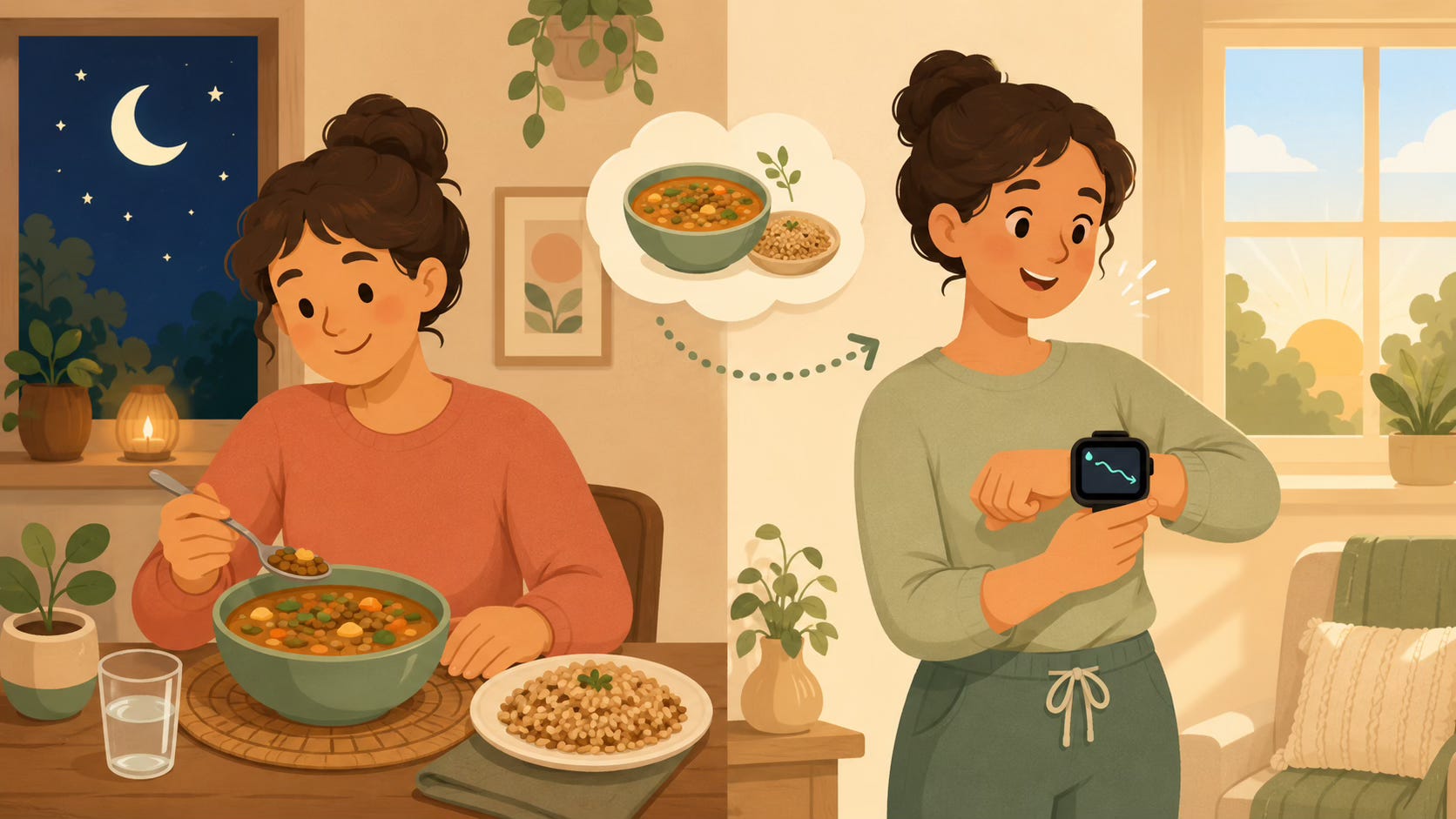
You ate a careful dinner last night. Grilled chicken, steamed vegetables, a reasonable portion. But this morning, your fasting glucose was higher than you expected. And the oatmeal you eat every single morning produced a spike on your CGM that looked just like yesterday’s. You’re doing everything right at each meal, and still your numbers won’t cooperate.
What if the problem isn’t what you’re eating at breakfast?
What if it’s what you ate, or didn’t eat, the night before?
There is a phenomenon in metabolic research called the second meal effect, and it does exactly what the name suggests. What you eat at one meal measurably changes how your body handles the next one, sometimes hours later, sometimes the following morning. The foods that drive it aren’t exotic or expensive. They’re lentils and beans and whole barley, the kind of whole foods most of us walk right past at the grocery store.
What Beans Did for Wheat Fields
For most of human agricultural history, farmers planted the same crop in the same field, season after season, until the soil gave out.
Then someone noticed a pattern. Fields where beans or clover had been grown the prior season produced dramatically better wheat the following year. Crop rotation became standard practice across Europe centuries before anyone understood why it worked.
In the 1880s, microbiologists found the answer. Bacterial colonies living in nodules on bean roots were pulling nitrogen out of the air and converting it into a form the soil could use. The beans weren’t just food for that season. They were feeding an invisible workforce underground, organisms that manufactured the raw materials the next crop would need.
The payoff showed up the next season in taller stalks and heavier grain. Something very similar happens inside your body between dinner and breakfast.
The Phenomenon Nobody Talks About
The observation that one meal affects the next was first described over a century ago. Researchers noticed that when they gave someone two glucose drinks a few hours apart, the second one always produced a smaller blood sugar spike than the first. They called it the Staub-Traugott effect and mostly left it there.
It took until the early 1980s for anyone to test whether this worked with real food. Seven healthy volunteers ate either lentils or wholemeal bread for breakfast, both meals containing the same amount of carbohydrate. Four hours later, everyone ate the same bread lunch. The lentil group’s blood glucose response to that identical lunch was significantly flatter.
A separate experiment in the same study turned up something even more interesting. When volunteers ate only a quarter portion of bread at breakfast, their blood glucose rose modestly and fell back to fasting levels within a couple of hours. Sounds great, right? But their glucose response to the lunch that followed was the worst of any group. The small breakfast hadn’t sustained enough metabolic activity to prime the system.
That finding gets at something important. The rate at which carbohydrate reaches your bloodstream in the first meal matters more than the amount. Slow, sustained delivery from foods like lentils sets up the body’s glucose-handling machinery for whatever comes next.
Two Mechanisms, Two Timescales
Four decades of research have now teased apart how the second meal effect works, and the answer depends on how long you wait between meals.
The same-day pathway operates over roughly four to five hours. When you eat breakfast, insulin suppresses circulating fatty acids in your blood. Those fatty acids, when elevated, interfere with your muscles’ ability to store glucose as glycogen. By suppressing them, that first meal opens up storage capacity for the second meal.
Imaging studies using carbon-13 labeled glucose made this visible. On days when subjects ate breakfast before lunch, muscle glycogen storage after lunch more than doubled compared to days when breakfast was skipped. And fatty acid levels right before lunch predicted the post-lunch glucose spike consistently. Low fatty acids, small spike. High fatty acids, big spike. The effect has nothing to do with producing more insulin. It’s about clearing the metabolic runway so the insulin you already have can do its job.
The overnight pathway is different, and it’s the one that connects most directly to the crop rotation story.
When you eat foods rich in indigestible carbohydrates at dinner, things like the fiber and resistant starch in lentils and beans and whole barley kernels, those carbohydrates pass through your small intestine undigested and reach your colon. There, bacteria ferment them into short-chain fatty acids, primarily butyrate and propionate. These enter your bloodstream, suppress the circulating fatty acids that block glucose storage, stimulate the satiety hormone PYY, and reduce inflammatory markers.
The evidence for this pathway is clear. When healthy adults ate brown beans versus white bread as an evening meal, next-morning blood glucose and insulin were both significantly lower after the beans. Satiety hormones were higher. Hunger hormones were lower. Inflammatory markers dropped. And breath hydrogen, a direct marker of colonic fermentation, was markedly elevated. The bacterial activity in the colon overnight was the engine driving all of it.
Just as bacteria in bean roots fix nitrogen for the next crop, bacteria in your colon convert dinner’s fiber into compounds that prime tomorrow morning’s glucose response.
Timing the Gap
Continuous glucose monitor data from one trial showed that a high-protein breakfast lowered post-lunch and even post-dinner glucose responses when lunch was eaten as usual. But when lunch was skipped, the dinner benefit was no longer statistically significant. The long fast allowed fatty acids to rebound, weakening the priming effect.
Timing also matters in the other direction. In adolescent girls, a mid-morning breakfast consumed about two hours before lunch reduced post-lunch glucose by more than a third compared to skipping breakfast. An early-morning breakfast four hours before lunch produced only a moderate, non-significant reduction. The closer the first meal to the second, the stronger the priming.
Each meal sets up the next, and skipping one lets the metabolic state reset.
Whole Beats Ground
If the overnight effect depends on colonic fermentation, then the food has to actually reach the colon. That turns out to depend less on how much fiber a food contains than on what shape it arrives in.
Intact whole grains and legumes consistently improve overnight glucose tolerance, with barley kernels and lentils showing the strongest results. The same grains milled into flour and cooked as porridge do not. In one comparison, barley porridge worsened the next morning’s glucose response even though its fiber content matched the intact kernels that had improved it.
The reason is structural. Starch inside a plant sits packed into cells, and those cell walls are a physical barrier that digestive enzymes have to work through slowly. Grinding shatters the walls and spills the starch where enzymes reach it immediately. It gets absorbed high in the small intestine and nothing is left over for the bacteria waiting downstream. Same grain, same grams of fiber on the label, completely different destination.
Chewing does not undo this. Your molars break a kernel into pieces a millimeter or two across, and the cells that matter are about a hundred times smaller than that. You cannot chew barley into flour.
Two things follow from this. On barley, look for hulled or whole grain barley rather than pearled if your store carries it, since whole grain kernels are what the research used. Most American supermarkets stock only pearled, which has had the outer bran polished off. Pearled is still a good choice, because barley stores most of its beta-glucan inside the grain rather than in the bran, which is unusual among cereals. A pearled kernel is a step down from hulled and an enormous step up from any flour.
On beans, relax. Legume cell walls are tougher than cereal cell walls, and legumes carry fermentable material that survives processing regardless of structure. Whole chickpeas outperform hummus when the two are tested head to head, but hummus still counts, and so do canned beans. This is a far more forgiving category than grains.
The one thing that doesn’t work is buying the fiber on its own. When researchers pulled fiber out of barley and stirred it into a meal at the amount you’d get from a normal serving of kernels, the overnight benefit didn’t appear. The kernel delivers fiber and resistant starch together, and the isolated fiber alone wasn’t enough fermentable material to do the job.
Your Microbiome Decides Whether You Respond
Here’s where individual differences enter the picture. When thirty-nine healthy adults ate barley kernel bread for three days, their glucose responses on the fourth morning split into two groups. Some people improved dramatically. Others barely changed. The difference tracked with gut bacteria. Responders had higher ratios of Prevotella relative to Bacteroides, bacterial communities better equipped to ferment complex plant carbohydrates. And when researchers transplanted microbiota from the human responders into germ-free mice, those mice showed improved glucose metabolism and increased liver glycogen storage. The bacteria were driving the effect, not just along for the ride.
This is why two people can eat the same dinner and wake up with very different fasting glucose numbers. The second meal effect is real at the population level, but how much any single person benefits depends on the microbial community they’ve been building.
The microbiome is not static. Consistently eating legumes, whole grains, and vegetables with prebiotic fiber shifts the community toward a composition that responds.
The Effect Works in Type 2 Diabetes
The second meal effect was assumed for years to be a healthy-person phenomenon, because early tests using plain glucose drinks in people with type 2 diabetes found nothing. Plain glucose triggers too little insulin to suppress fatty acids, so the priming step never happened.
Real mixed meals told a different story. When people with type 2 diabetes ate breakfast before lunch, the post-lunch glucose response was dramatically lower than when breakfast was skipped, driven by the same fatty acid suppression seen in healthy subjects.
In people with diet-controlled or metformin-controlled type 2 diabetes, a small soy-based snack eaten two hours before breakfast reduced the post-breakfast glucose spike by approximately forty percent. The snack itself caused only a minimal rise in glucose, but the insulin it triggered suppressed fatty acids enough to prime the system for the bigger meal that followed.
Choose Your Easy
The hard way to manage blood sugar is to fight every meal independently, treating each one as a standalone battle against glucose.
The easier way is to set up each meal for success by investing in the one before it. A bowl of lentil soup at dinner tonight is working for you while you sleep. A breakfast with steel-cut oats or beans is clearing the runway for a smoother lunch.
In an eight-week clinical trial, metabolically at-risk adults who received five prepared midday meals per week containing lentils instead of meat reversed the rising insulin resistance that the meat-only control group experienced. The effect was dose-dependent, and the vast majority of participants reported no more than mild digestive symptoms.
Your Monday Habit
Tonight, add half a cup of cooked lentils, beans, or barley to dinner.
Brown or green lentils are the easiest starting point. They need no soaking and cook in about twenty minutes in plain water. Canned beans of any kind work, black or pinto or chickpea, and all they need is a rinse to cut the sodium. Barley takes longer, roughly fifty minutes for hulled and twenty-five for pearled, which makes it the one worth cooking a batch of on a Sunday and keeping in the refrigerator. Stir lentils into whatever soup you were already making, put beans on a salad, and serve barley where you would have served rice.
Do it three nights this week rather than once. The bacteria doing the overnight work respond to repetition, and the trials that produced the strongest results ran several days in a row.
If you wear a CGM, write down tomorrow’s fasting number and compare it to a morning after a dinner with none of this in it. If you don’t wear one, you will notice it a different way. Most people report they simply aren’t as hungry at breakfast.
Farmers figured out centuries ago that the richest harvests came from fields planted with the right crops in the right order. Your metabolism works on the same principle, and dinner is where the next morning’s harvest begins.
The Habit Healers is a physician-led program designed to reverse insulin resistance through small daily habits, exactly like this one. The program is CGM-based, organized into five stations, and includes weekly live coaching on Tuesdays with Dr. Laurie, Chef Martin’s plant-forward recipe library (with plenty of lentil and bean recipes), a printable workbook, and a private community of people doing this work together. If you want guidance building these habits into your routine, join us on Skool.
References:
Jenkins DJ, Wolever TM, Taylor RH, et al. Slow release dietary carbohydrate improves second meal tolerance. Am J Clin Nutr. 1982;35(6):1339-1346. doi:10.1093/ajcn/35.6.1339
Jovanovic A, Leverton E, Solanky B, et al. The second-meal phenomenon is associated with enhanced muscle glycogen storage in humans. Clin Sci (Lond). 2009;117(3):119-127. Published 2009 Jul 2. doi:10.1042/CS20080542
Nilsson A, Johansson E, Ekström L, Björck I. Effects of a brown beans evening meal on metabolic risk markers and appetite regulating hormones at a subsequent standardized breakfast: a randomized cross-over study. PLoS One. 2013;8(4):e59985. doi:10.1371/journal.pone.0059985
Kovatcheva-Datchary P, Nilsson A, Akrami R, et al. Dietary Fiber-Induced Improvement in Glucose Metabolism Is Associated with Increased Abundance of Prevotella. Cell Metab. 2015;22(6):971-982. doi:10.1016/j.cmet.2015.10.001
Peng X, Fan Z, Wei J, et al. Fresh-Cooked but Not Cold-Stored Millet Exhibited Remarkable Second Meal Effect Independent of Resistant Starch: A Randomized Crossover Trial. Nutrients. 2024;16(23):4030. Published 2024 Nov 25. doi:10.3390/nu16234030
Higgins JA. Whole grains, legumes, and the subsequent meal effect: implications for blood glucose control and the role of fermentation. J Nutr Metab. 2012;2012:829238. doi:10.1155/2012/829238
