


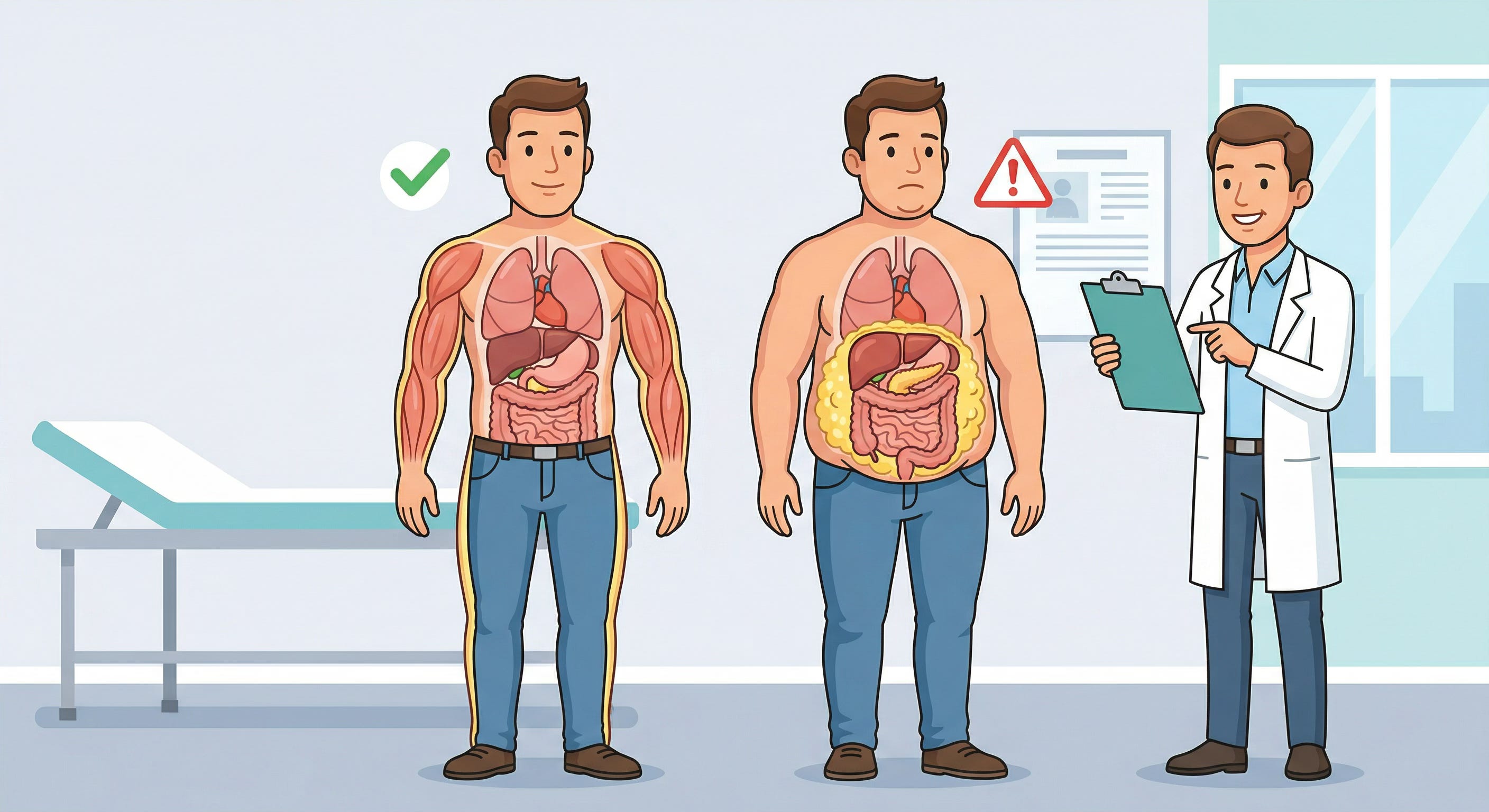
Picture two men standing side by side in a doctor’s office. They are the same height, the same weight, and share a BMI of 27. The doctor glances at the chart and tells them both the same thing. “Your BMI is a little high, so let’s keep an eye on it.”
One of those men carries 22% body fat, most of it stored under the skin of his arms and legs. He’s muscular, metabolically healthy, and his blood work is clean. The other carries 38% body fat, most of it packed around his liver, his intestines, and his pancreas. His fasting blood sugar is creeping up, his triglycerides are elevated, and he’s developing insulin resistance. He has no idea.
Their BMI is identical, but their health trajectories could not be more different.
A 2025 study followed U.S. adults aged 20 to 49 for 15 years and found that high body fat percentage was tied to significantly increased mortality, while overweight or obese BMI showed no statistically significant relationship with mortality at all. BMI missed the signal entirely, while body fat percentage caught it.
That finding shouldn’t surprise anyone who has thought carefully about what a bathroom scale actually measures. Your scale gives you one number. That number is the combined weight of your bones, your organs, your water, your muscle, and your fat. It cannot tell you how much of that weight is fat. It cannot tell you where that fat is stored. And it cannot tell you whether the ratio of fat to muscle in your body is already setting you up for metabolic disease.
There are three numbers that matter more than your weight. Body fat percentage, body fat in pounds, and visceral fat. Most people have never measured any of them. And the habits that change these numbers are different from the habits that change what you see on the scale.
Three Numbers, Three Different Stories
Consider a woman who weighs 180 pounds and carries 30% body fat. That means 54 pounds of her body weight is fat and 126 pounds is lean mass (muscle, bone, water, organs). She starts strength training and eating more protein, and six months later she still weighs 180 pounds. Her doctor tells her the diet isn’t working.
But her body fat has dropped to 25%. She now carries 45 pounds of fat and 135 pounds of lean mass, having traded nine pounds of fat for nine pounds of muscle. Her metabolic profile is dramatically better, her insulin sensitivity has improved, and the scale never moved.
This is why body fat percentage tells a different story than weight. And it’s why body fat in pounds (which you calculate by multiplying your weight by your body fat percentage) reveals what’s actually happening during a body recomposition that the scale completely hides.
BMI is even less informative, because it’s simply a ratio of weight to height that treats every pound the same, whether it’s bone or belly fat. A muscular person and a sedentary person can share an identical BMI while facing completely different health risks. Research using DEXA scans has shown that a significant portion of people classified as “overweight” by BMI are actually in the wrong category when their body fat is directly measured.
Then there is the problem that most concerns physicians who study metabolic disease, a phenomenon called TOFI, which stands for “thin outside, fat inside.” MRI imaging studies have revealed that roughly one in eight adults with a normal BMI carry dangerous amounts of visceral fat that is completely invisible from the outside. Two men with the same BMI of 25 have been shown to carry vastly different amounts of internal fat, with one harboring several times more visceral fat than the other. No external measurement, no scale, no mirror would reveal this.
And there is a related condition that becomes increasingly common after age 45 called sarcopenic obesity. This is the simultaneous loss of muscle mass and gain of fat mass, and it happens so gradually that most people never notice. Over each decade, you lose a few pounds of muscle and gain a few pounds of fat, so your weight and BMI barely change. But your body composition is deteriorating underneath, and with it, your metabolic health.
Longitudinal data shows that even weight-stable older adults lose fat-free mass while gaining fat mass. The scale provides the most dangerous form of false reassurance in metabolic health.
The distinction between visceral fat and subcutaneous fat (the fat under your skin) is where the biology gets most interesting. Subcutaneous fat is the fat you can pinch, sitting between your skin and your muscles. Visceral fat is something else entirely, wrapping around your internal organs inside the abdominal cavity and surrounding your liver, your intestines, and your kidneys.
The reason visceral fat is so dangerous comes down to plumbing. Visceral fat drains directly into the portal vein, which feeds straight into the liver. This means the free fatty acids and inflammatory molecules that visceral fat releases are delivered at high concentration directly to the organ responsible for managing your blood sugar, your cholesterol, and your inflammatory response. The result is insulin resistance in the liver, increased production of the cholesterol particles that drive heart disease, and a chronic low-grade inflammatory state that accelerates aging.
Subcutaneous fat, by contrast, drains into the general circulation. Its metabolic effects are diluted. Some research even suggests that subcutaneous fat in certain locations may be protective, acting as a metabolic buffer.
So the question is not “how much do I weigh?” or even “how much fat do I carry?” The question that predicts your metabolic future is this. Where is my fat, and am I losing muscle underneath it?
The 100 cm² Line
In research labs that study visceral fat, one number keeps showing up as a clinical threshold. That number is 100 cm² of visceral fat area, measured by CT scan at the level of the lower spine.
A 2025 study examined a large health screening dataset of individuals with normal body weight. Even in this lean population, those whose visceral fat area exceeded 100 cm² had dramatically higher rates of metabolic syndrome. Their BMI was completely normal, but their visceral fat was not. The exact threshold varies depending on the population studied and the imaging method used, but 100 cm² has emerged as a commonly referenced benchmark across multiple research groups.
Who accumulates visceral fat, and how quickly, depends heavily on sex and hormonal status.
Men, on average, carry a higher proportion of visceral fat at a given BMI than premenopausal women. This is partly why men develop metabolic disease at lower levels of total body fat than women do. But menopause changes the equation dramatically. A 2022 review documented the scope of this shift. During the menopausal transition, women accumulate 36% more trunk fat and 49% more intra-abdominal fat compared to premenopausal women. This visceral fat accumulation is linked to insulin resistance, inflammation, and unfavorable cholesterol changes. Estrogen, it turns out, actively directs fat storage toward the under-the-skin compartments and away from the visceral compartments. When estrogen declines, that protective routing collapses, and fat begins accumulating in the dangerous internal locations.
Men face a parallel problem as testosterone declines with age. Lower testosterone is linked to greater visceral fat accumulation, and visceral fat itself produces an enzyme that converts testosterone to estrogen, creating a cycle that feeds on itself.
Here is where the mortality data becomes particularly relevant for adults over 45. A large meta-analysis pooling data from dozens of long-term studies found a J-shaped relationship between body fat percentage and all-cause mortality. The lowest mortality for men was at about 22% body fat. For women, it was around 35%. Women naturally carry more essential fat than men, which is why the lowest-risk percentage for women is higher than most people expect.
The most important finding for older adults is that in people over 60, higher body fat percentage showed no significant increase in mortality risk. This supports what researchers call the “obesity paradox,” where moderate body fat appears protective in older populations. The danger for adults over 45 is not carrying some extra fat. The danger is carrying that fat in the wrong place (viscerally) while simultaneously losing muscle underneath it.
Now what?
You know the numbers that matter and why your scale isn’t showing them.
Below, you’ll find how to:
actually measure body fat and visceral fat at home,
the specific home scales that performed best in peer-reviewed testing,
the seven lifestyle levers that move these numbers with their minimum effective doses,
and a printable body composition tracking worksheet you can start using this week.
Upgrade now to access the full protocol and printable worksheet.
