


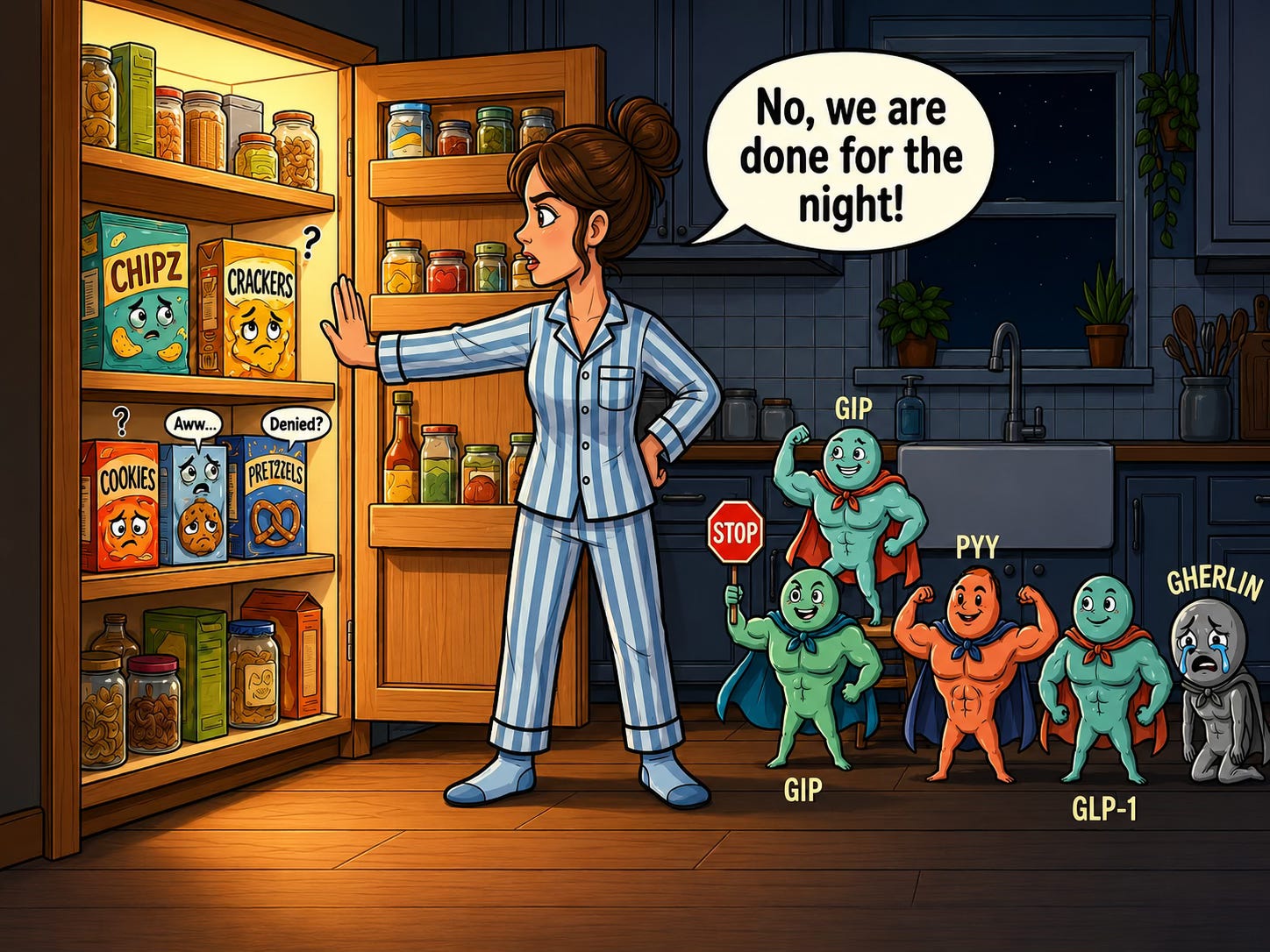
She’s been watching what she eats for years, and on this particular evening she made herself a dinner that looked perfect. Grilled vegetables, a scoop of brown rice, a piece of fruit for dessert. She ate it at the kitchen table without restricting and without rushing, just eating until she felt done before putting the plate in the sink and heading to the couch.
Ninety minutes later she was back in the kitchen, standing in front of the open pantry, reaching for the crackers, unable to figure out why a perfectly reasonable dinner kept failing to hold.
Most people would recognize this scene. And most of us, when it happens, reach for the same explanation. We need more discipline. But what if the problem wasn’t with the woman, or with the food, or with her willpower? What if the problem was with the conversation between the food and her body, a conversation that was supposed to happen and didn’t?
Because that’s what satiety actually is, a conversation between your food and your gut. Your gut produces a cascade of chemical signals after every meal, and those signals are supposed to tell your brain, firmly and clearly, you’ve had enough. When the conversation works, you eat a reasonable amount and feel satisfied for hours. Your protein needs get met without counting grams. Your blood sugar holds steady. And your body produces the same fullness hormones that are now making headlines as injectable medications.
When the conversation breaks down, none of that happens. And what most people never learn is that the conversation depends almost entirely on the structure of the meal, on what you eat first, how fast you eat it, what kinds of fiber are in it, and whether you take a walk afterward.
There are ten specific habits that fix this conversation. Each one targets a different part of the digestive tract. But before we get to those habits, we need to understand the signal itself. Because once you see how it works, the habits stop looking like a checklist and start looking like the only thing that makes sense.
The Array
In April 2019, the world saw the first photograph of a black hole. You probably remember the image, that glowing orange ring on the front page of every newspaper on the planet. What fewer people learned is how it was actually taken.

No single telescope on Earth is powerful enough to photograph a black hole 55 million light-years away. So a team of astronomers linked eight modest radio dishes on four continents, from Hawaii to the South Pole. Each dish alone picked up noise. But combined through a technique called interferometry, they synthesized the resolving power of an antenna the size of the Earth. Together, eight small dishes saw what no single instrument ever could.
Your body’s satiety system works the same way.
There is no single fullness switch. What you have instead is an array of stations spread along thirty feet of digestive tract, each with its own detector cells and its own chemical signals. One senses stomach volume. Another detects fat and protein arriving in the upper intestine. A third releases the very molecule that GLP-1 medications are built to mimic. A fourth responds to fiber that gut bacteria have been fermenting for hours. Each signal alone is small and short-lived. But when they fire in sequence, they combine into something the brain reads as deep, lasting satisfaction.
Most modern meals only activate one or two of these stations. A bowl of sweetened cereal with skim milk hits the upper gut and that’s about it. The stomach empties fast, the lower intestine never gets recruited, and the colon sits idle. The brain gets a thin signal that fades within an hour, even though the calories were adequate.
This is why calorie counting feels like war. The opponent isn’t your appetite. It’s a communication failure. And the fix isn’t eating less food. It’s eating food that makes every station fire.
The five hormones that run this system are GLP-1, GIP, CCK, PYY, and ghrelin. GLP-1 is the one behind the most talked-about medications right now. But these aren’t pharmaceutical inventions. They’re yours. Your gut makes them after every meal. The question is whether the meal gives those cells what they need.
A Meal’s Path Through Your Body
To understand why some meals hold you for four hours while others fail in sixty minutes, follow a bite of food through the gut and watch what happens at each station.
It starts before you swallow. When you see food and begin to chew, your brain fires a signal down the vagus nerve to prepare the stomach and pancreas. This warm-up phase primes the digestive system for what’s coming. A meal eaten slowly gives the system time to prepare. A meal eaten in eight minutes while scrolling a phone skips the warm-up, and the signals that follow are weaker for it.
When food arrives in the stomach, stretch receptors in the wall begin to fire based on volume, not calories. They can’t tell broccoli from brownies. They just measure how full the stomach is and report it to the brain. At the same time, ghrelin (the hunger hormone) starts to drop. But what you ate determines how long it stays down. Protein suppresses ghrelin the longest and deepest. Starch and sugar cause a fast initial drop followed by a rebound above baseline hours later (37% higher in one study), which is why a big plate of pasta can leave you hungry by mid-afternoon. Fat is the weakest suppressor. The stomach also controls the pace of everything downstream. Anything that slows gastric emptying (fiber, protein, fat, vinegar) slows the arrival of nutrients at every station below, giving each one time to fire.
In the upper small intestine, the first hormone factory comes online. Specialized cells release CCK within about ten minutes of a mixed meal arriving, an eight-fold spike that contracts the gallbladder, triggers digestive enzymes, tightens the valve between the stomach and intestine, and sends the first chemical “enough” signal directly to the brainstem. Fat and protein are strong CCK triggers. Starch and sugar are much weaker.
Further down, in the lower small intestine, the signal gets serious. L-cells here release GLP-1, the molecule behind semaglutide and tirzepatide. GLP-1 slows gastric emptying, amplifies insulin, and signals fullness to the brain. But its half-life is only about two minutes. An enzyme breaks it down almost immediately, so most of the GLP-1 you produce works locally through nerve endings right next to the cell that made it. The injectable versions are engineered to last days instead of minutes. Your body’s version depends on meals that keep delivering nutrients to these cells over time, not meals that get absorbed too high and too fast. L-cells also release PYY, which rises within fifteen minutes, peaks around an hour, and stays elevated for hours, directly inhibiting the hunger circuits in the brain. Together, GLP-1 and PYY create what’s called the “ileal brake,” a mechanism that slows the entire upper gut and tells the brain to stop eating.
This is why the order you eat food matters. When you eat vegetables and protein before starch, you slow gastric emptying so that more nutrients reach these lower cells. A crossover trial tested this directly and found that eating the starch last, after vegetables and protein, reduced the glucose spike by 53% and raised GLP-1 significantly, with the same food and the same calories.
Most people think digestion ends when food reaches the large intestine. It doesn’t. L-cells line the colon in even higher density, but down here they respond to something different: short-chain fatty acids, the byproducts of bacteria fermenting fiber. When you eat legumes, oats, onions, garlic, or resistant starch, those fibers arrive in the colon intact, and bacteria break them into compounds that trigger a second wave of GLP-1 and PYY hours after the meal. Research suggests this creates a “second meal effect,” where fiber eaten at dinner improves satiety and glucose control at breakfast the next morning.
All of these signals converge on the brain, where two groups of neurons compete. One group suppresses appetite in response to GLP-1 and PYY. The other drives hunger in response to ghrelin. Every meal is a contest between them, and the outcome depends on how many stations fired and how strongly.
You may have heard of leptin, often called “the satiety hormone.” Leptin plays a real role, but not at the meal level. It’s produced by fat cells and reflects how much energy your body has stored over weeks and months. Leptin sets the gain on the entire system, determining how responsive your brain is to the gut signals coming in. When leptin drops (from crash dieting or sleep deprivation), the brain reads it as starvation and turns up hunger regardless of what the gut reports. This is why sleep matters so much and why crash diets backfire. But leptin is not something you can tune with meal choices. The five gut hormones above are the ones you can influence, meal by meal, with the habits that follow.
Where This Leaves You
Now you can see why a bowl of cereal fails in an hour (it barely activates two stations) and why a lentil stew with roasted vegetables holds you for half a day (it fires every station from stomach to colon, with enough fiber left over to feed the colonic wave at your next meal).
Below are ten evidence-backed habits that recruit these stations, each mapping to a specific part of the cascade. The printable tracking worksheet attached to this article connects each habit to the part of the gut it targets.
Upgrade your subscription to access the full protocol, the printable Satiety Habits worksheet, and the complete Habit Healers library. Your subscription supports independent, evidence-based health journalism by a physician with over 2 decades of clinical experience.
