


You walk into the kitchen and stop. You had a reason for coming in here. A good reason. But now you’re standing next to the refrigerator with absolutely no idea what it was.
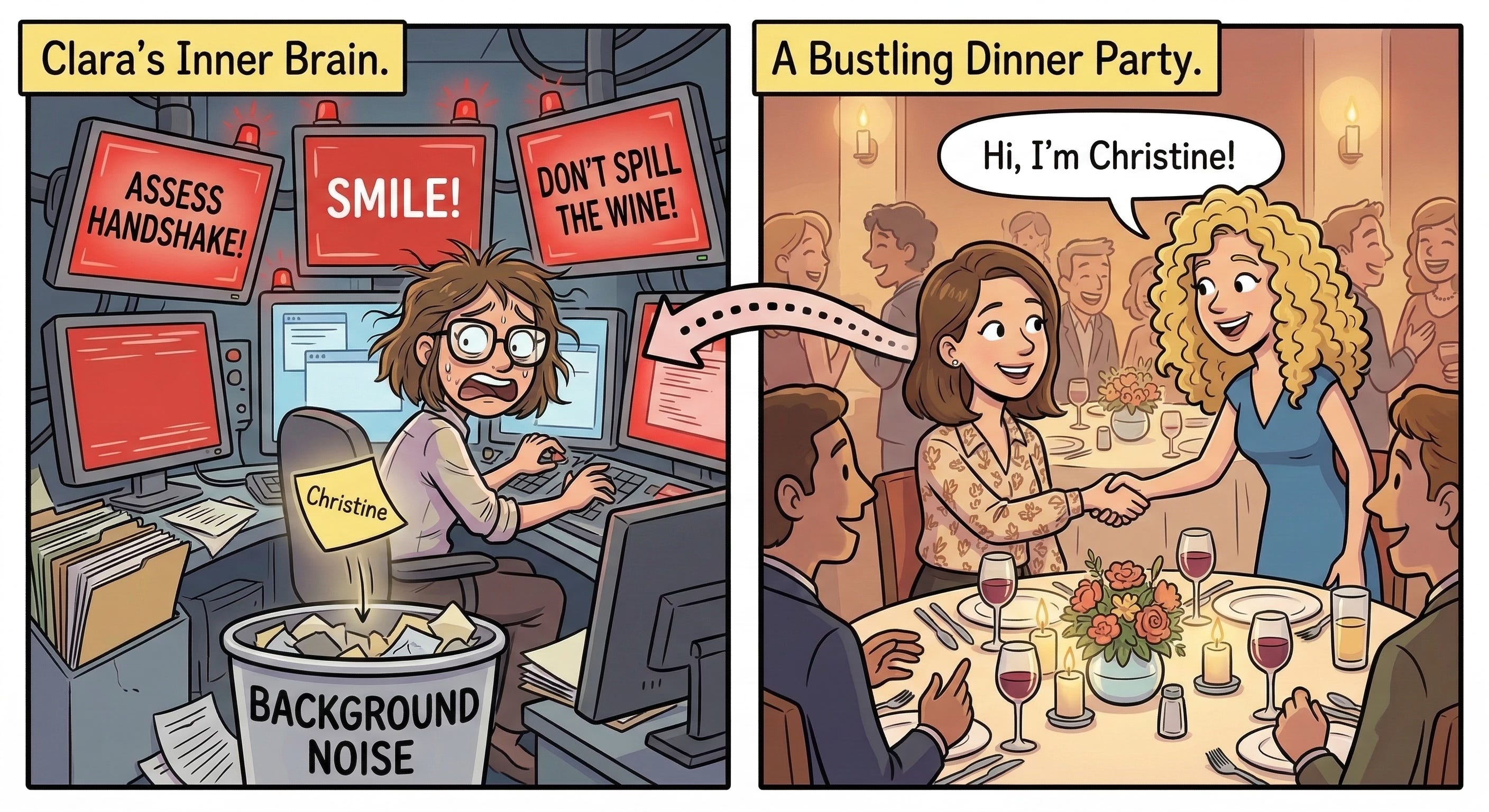
Or you’re at a dinner party, and the woman across the table just introduced herself. Her name was... something. You heard it five seconds ago. It’s already gone.
If you’re over 45, these moments come with a side of low-grade panic. You laugh it off, but later, alone, you wonder, is this just getting older, or is this the beginning of something worse?
The answer depends less on your age than you might think. It depends on what’s happening inside your skull every time your brain tries to hold onto a piece of information, and whether the conditions are right for that information to stick. Because memory isn’t a single thing. It’s a collection of systems, each with its own hardware, running in different parts of your brain. And the good news is that more of what determines whether a memory survives or disappears is under your control than you’d expect.
To understand why, we need to look at how a memory actually gets built.
Your Brain’s Filing System
For most of the 20th century, scientists assumed memory was one thing. You either had a good memory or a bad one. That changed with a patient known as H.M.(Henry Molaison), whose surgeons removed much of his hippocampus and the surrounding medial temporal lobe structures to treat severe epilepsy. After the surgery, H.M. could no longer form new memories of events. He couldn’t remember what he had for breakfast or whether a visitor had come to see him an hour earlier. But he could learn new motor skills. He learned to trace a shape while looking in a mirror, improving steadily over three days of practice, even though each day he had no memory of ever having done the task before.
H.M. revealed something fundamental: memory is not one system. It’s several, and they operate through different brain structures.
The broadest division is between working memory and long-term memory. Working memory is your mental scratchpad. It holds a phone number long enough for you to dial it, or keeps track of the beginning of a sentence while you read to the end. It depends heavily on the prefrontal cortex, the region behind your forehead that handles planning and attention. Working memory is small. Most people can hold about four chunks of information in it at once, and without active effort, that information fades within seconds.
Long-term memory is where things get interesting. It splits into two broad categories. The first is declarative memory, which covers everything you can consciously recall. This includes episodic memory (your personal experiences, like the details of your last birthday) and semantic memory (general knowledge, like knowing that Paris is the capital of France). Declarative memory depends on the hippocampus and surrounding structures in the medial temporal lobe.
The second category is nondeclarative memory. This is the stuff you know how to do without thinking about it. Riding a bicycle. Typing on a keyboard. These skills and habits run through the basal ganglia and the cerebellum, brain structures that specialize in learned motor patterns. A separate nondeclarative system, centered on the amygdala, handles emotional learning: the gut-level reactions that make you flinch when something flies at your face or tense up when you walk into a place where something bad once happened. These nondeclarative systems were still working in patient H.M. The surgery removed much of his hippocampus, but his basal ganglia and cerebellum were intact. So he could still learn a new physical skill, even though he couldn’t remember doing it.
The amygdala also plays a special role in everyday memory. It modulates how strongly other memories get encoded based on emotional intensity. This is why you remember your wedding day in sharp detail but can’t recall what you had for lunch last Wednesday. The emotional charge at the moment of encoding acts like a volume knob, telling the hippocampus to pay closer attention. One important footnote: emotion makes memories feel more vivid, but vivid doesn’t always mean perfectly accurate. Your confidence in the memory goes up, even when some of the details are off.
How a Memory Becomes Permanent
Forming a memory and keeping a memory are two different biological processes. When you first experience something new, your hippocampus rapidly encodes it. Neurons fire together, and the connections between them strengthen through a process called long-term potentiation. Think of it as a path through a field: the first time you walk it, you’re pushing through tall grass. But each time you walk the same path, the trail gets more defined.
That initial encoding is fragile. Within hours, the new connections need to be stabilized through protein synthesis at the synapses. This is called synaptic consolidation. If that consolidation window gets disrupted, especially by sleep loss or major physiologic stress, the memory is more likely to be forgotten.
But synaptic consolidation is only the first step. Over weeks, months, and sometimes years, a second process unfolds: systems consolidation. During this phase, the hippocampus gradually trains the neocortex to store the memory more independently. The hippocampus acts like a temporary instructor, replaying the memory pattern over and over until the cortex can reconstruct it on its own. This isn’t a literal file transfer from one location to another. The cortex is involved from the very beginning. What changes over time is the balance. The hippocampus becomes less essential, and the cortical connections become stronger. This is why patients with hippocampal damage typically lose recent memories but can often recall events from decades earlier. Those older memories have shifted toward cortical storage and depend less on the hippocampus.
The most important window for this replay process is sleep. During slow-wave sleep (the deepest stage of non-REM sleep), the hippocampus generates sharp-wave ripples, brief bursts of neural activity that replay the day’s experiences in compressed form. These ripples sync up with slow oscillations in the prefrontal cortex and with sleep spindles (short bursts of activity generated by the thalamus). This coordinated electrical conversation between brain regions is what moves a memory from temporary hippocampal storage toward permanent cortical storage. Sleep after learning generally improves retention, and sleep loss reliably worsens it. The memory was formed during the day, but sleep is when it gets filed for the long term.
Why Stress Is the Enemy of Memory
The same system that helps emotional memories stick can backfire when stress becomes chronic. Short bursts of stress hormones (particularly cortisol) actually enhance memory formation. That’s useful. You want to remember the dangerous situation so you can avoid it next time. But when cortisol stays elevated for weeks or months (from ongoing work pressure, relationship conflict, financial strain, or poor sleep), it starts to take a toll on the hippocampus. The neurons in this region are especially sensitive to prolonged cortisol exposure. Over time, chronic stress is associated with changes in hippocampal structure and function, including reduced volume in some studies. These effects may be partly reversible when the stress resolves, but while the stress is ongoing, the memory system pays the price.
This is one reason people under chronic stress often describe their memory as “foggy.” The hardware responsible for encoding new experiences is being degraded by the very hormones that were supposed to protect them.
You now understand the machinery: how your brain builds different types of memories, why sleep is the critical maintenance window, and how chronic stress can steadily erode the system. But understanding the biology is only half the picture.
Below, subscribers get the complete Memory Protection Protocol:
the highest-rated encoding strategies from a landmark review of learning techniques,
practical methods for remembering names, numbers, and grocery lists without your phone,
the lifestyle habits with the strongest evidence for long-term brain protection,
and a clear checklist for when forgetfulness crosses the line from normal to worth a doctor’s visit.
You’ll also get the printable Memory Protection Protocol worksheet with step-by-step instructions, a weekly tracking grid, and a red flags guide.
Upgrade now to access the protocol and printable worksheet.
