

Why Do More Heart Attacks Happen Before Breakfast Than at Any Other Time of Day?
Nine Simple Habits That Tame the Most Dangerous Hour for Your Heart

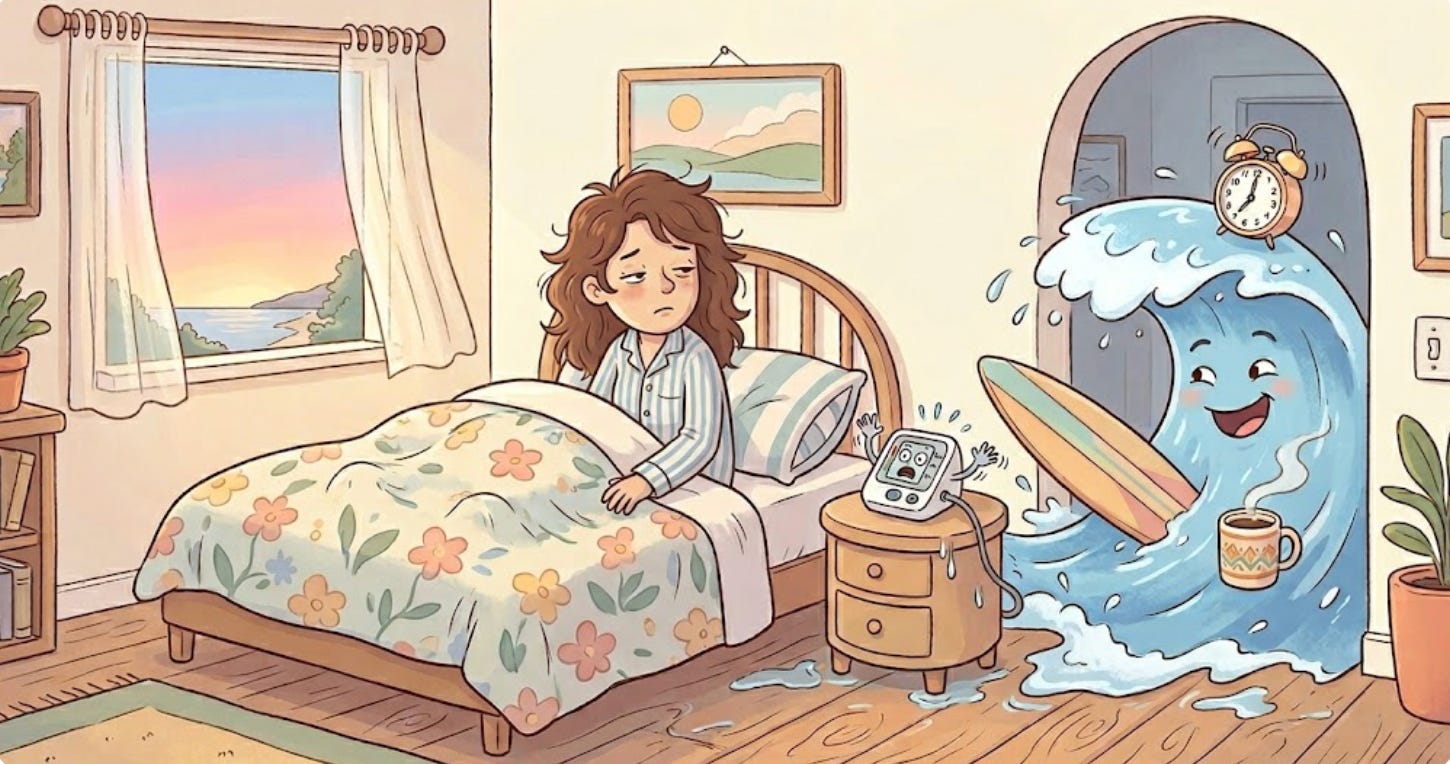
Twice a day, the ocean rises and falls. This is the tide, driven by the pull of the moon, and it is one of the most predictable forces on the planet. Along most coastlines, the rising water simply spreads across the beach and retreats. But on certain rivers, where the ocean meets a narrowing channel, the incoming tide does something different. Instead of spreading out, it gets funneled upstream. The water stacks up, gains speed, and forms a wave that rolls miles inland against the river’s current.
On the River Severn in England, people gather on the banks before sunrise several times a year to watch this happen. The wave can be waist-high, fast enough to surf, and loud enough to hear from a distance.
This wave is called a tidal bore. Whether it arrives as a gentle ripple or a wall of water depends on how high the incoming tide is, how narrow the channel has become, and how low the river had dropped before the tide arrived.
Your cardiovascular system runs its own tidal bore every morning.
While you sleep, blood pressure sinks to its lowest point of the day, typically falling 10 to 20 percent below daytime levels. Then, in the final hours before dawn, a wave of hormones and nerve signals begins to push pressure upstream. Cortisol spikes, adrenaline surges, and the renin-angiotensin system fires while blood thickens and platelets become stickier.
In most people, this morning rise is smooth. The vascular system absorbs it the way a wide, open river mouth absorbs an incoming tide. But in some people, the surge is a wall of water. And unlike a river, your arteries can’t just flood the banks without consequence.
This is why heart attacks and strokes cluster between 6 AM and noon. The hour of awakening, not the hour on the clock, is the strongest predictor of cardiovascular crisis.
The question isn’t whether you have a morning blood pressure surge. Everyone does. The question is whether yours is a ripple or a wave. And if it’s a wave, what exactly is making it so big?
The Morning Tide
To understand what happens to your blood pressure every morning, it helps to think about what makes a tidal bore gentle or destructive.
The incoming tide is your sympathetic nervous system waking up. When you shift from deep sleep to wakefulness, adrenaline-like hormones rise sharply. Cortisol, which has been climbing since the early hours of sleep, peaks about 30 to 45 minutes after your eyes open. That cortisol makes your blood vessels more sensitive to those stress hormones, amplifying their ability to tighten the vessels. At the same time, another hormone system called the renin-angiotensin-aldosterone system kicks in, tightening vessels further and holding onto sodium.
At the same time, your blood itself is changing. Viscosity is higher in the morning, platelets clump more easily, and the enzyme your body uses to dissolve small clots drops to its daily low.
The shape of the channel is your arterial compliance. Young, flexible arteries stretch to accommodate the surge the way a wide river mouth absorbs an incoming tide. Stiff arteries, whether from aging, chronic inflammation, high sodium intake, or years of inactivity, funnel that surge into a much narrower passage. The wave gets bigger even when the tide stays the same.
The overnight low is the nocturnal dip. In healthy sleepers, blood pressure drops meaningfully during the night. That low river level means the morning tide has room to rise without flooding. But if blood pressure never dipped, if the river was already running near the top of its banks, the bore doesn’t need to be tall to cause damage. It just needs to crest.
Both the absolute morning level and the size of the surge carry risk. But across populations, the absolute morning level is the more reliable predictor. A moderate surge on top of a low overnight dip is far less dangerous than a small surge on top of a night that never really dipped at all.
When the Bore Turns Destructive
The damage from an oversized morning surge is measurable, and it accumulates long before you feel a thing.
In a prospective study of more than 500 older adults with hypertension, researchers performed ambulatory blood pressure monitoring and brain MRI scans at baseline, then followed the patients for an average of about three and a half years. Those whose morning surge fell in the highest category had nearly three times the stroke risk compared to the rest of the group, even after the analysis controlled for their overall 24-hour blood pressure. The MRI data added another layer. At the very start of the study, before any clinical events had occurred, the highest-surge group already had markedly more silent brain infarcts on imaging. The structural damage was accumulating invisibly, stroke by stroke, with no symptoms to announce it.
A second, larger study took this further. Researchers pooled ambulatory blood pressure data from nearly 6,000 people across eight populations and followed them for a median of more than 11 years. Those in the highest category of sleep-trough morning surge had significantly elevated risks of death from any cause and of cardiovascular events overall, including coronary events. The findings held after adjustment for age, sex, body weight, smoking, diabetes, cholesterol, and the nighttime blood pressure level itself. But an important detail emerged from this analysis. The preawakening surge, the rise that happens before you actually wake up, was not prognostic. What mattered was the total distance between the lowest overnight pressure and the morning peak. In other words, what happened during sleep shaped the severity of the morning wave just as much as the wave itself. A high river predicts a destructive bore even when the tide is ordinary.
Five Reasons Your Bore Might Be Too Big
If morning blood pressure is universally elevated by the dawn surge, why do some people get a destructive bore while others get a ripple? The answer usually involves more than one of these factors working together.
The channel has narrowed. As arteries stiffen with age, chronic inflammation, or prolonged inactivity, they lose their ability to absorb the morning surge. Pulse wave velocity, a measure of how fast a pressure wave travels through the arterial tree, rises with stiffness. And research consistently links higher arterial stiffness with a larger morning surge. The same tide hitting a narrower channel generates a bigger wave.
The river never dropped. In a healthy pattern called “dipping,” nighttime blood pressure falls at least 10 percent below daytime values. But a significant proportion of people with hypertension are “non-dippers” or even “reverse dippers” whose pressure stays flat or actually rises overnight. When the river is already high, the bore crests with less provocation. A study of hypertensive men who underwent both 24-hour blood pressure monitoring and overnight sleep studies found that those with a nondipping pattern had far higher rates of significant obstructive sleep apnea compared to those who dipped normally. The adjusted odds of meaningful sleep apnea were more than five-fold higher in the nondipping group. The average sleepiness score in the study was low. These were men who did not feel tired during the day. They did not fit the classic profile of a sleep apnea patient. Based on symptoms alone, they never would have been screened.
The tide is chemically amplified. If you are salt-sensitive, and a substantial percentage of people with hypertension are, your kidneys may not be able to clear enough sodium during the day. Overnight, they compensate by keeping blood pressure elevated to force sodium out through the kidneys. That keeps the river high all night. And potassium, which promotes sodium excretion and protects blood vessel walls, is the missing counterbalance. Most people consuming a typical diet fall well below recommended potassium levels.
The floodgates open too fast. Your autonomic nervous system is supposed to ramp up gradually on waking. But several amplifiers can turn that gradual ramp into an abrupt spike. Cold bedrooms trigger sympathetic activation. Jarring alarm clocks do the same. Jumping straight from horizontal to vertical without a transition period allows blood to pool in the legs, triggering a compensatory blood pressure overshoot. And evening alcohol, through its rebound effect on the sympathetic nervous system during the second half of the night, sets the stage for a larger morning surge hours before you wake up.
The medication ran dry. Short-acting blood pressure medications taken in the morning may lose their effect by the next dawn. A drug with a short half-life can leave a gap in coverage during the exact hours when the bore arrives. This is the trough effect, and it is one of the most common reasons morning blood pressure remains elevated despite otherwise adequate treatment.
The channel lining has lost its protection. Your blood vessels depend on nitric oxide to stay relaxed and flexible. Overnight, nitric oxide levels drop as the enzymes that produce it slow down during sleep. When the surge arrives at dawn, the vessels are less able to dilate in response. This is especially pronounced with age, in people who eat a low-vegetable diet, and, perhaps surprisingly, in anyone who uses antibacterial mouthwash daily. The bacteria in your mouth that convert dietary nitrate into nitric oxide are the same ones that antibacterial rinses are designed to kill.
Why Your Doctor Might Not See the Bore
A standard office blood pressure reading misses the bore entirely. By the time you drive to the clinic, sit in the waiting room, and roll up your sleeve at 10 AM, the bore has already passed. Your blood pressure at that moment may look perfectly reasonable. And if you’re being treated for hypertension and your in-office numbers are on target, your doctor has every reason to believe the medications are working.
But research consistently shows that a meaningful fraction of treated patients have what is called masked morning hypertension. Their office readings are normal. Their morning readings, taken at home before the commute and the coffee and the office visit, are not.
An international consensus panel defined morning hypertension as a home morning blood pressure averaging 135/85 mmHg or higher, regardless of what the office reading shows. For people at higher risk, including those with diabetes, coronary artery disease, protein in the urine from kidney involvement, heart failure, or who take anticoagulant or antiplatelet medications, the target is stricter, below 125/75 mmHg.
The same consensus defined exactly how morning blood pressure should be measured. Take it within one hour of waking, after urinating, before any medication or breakfast. Sit with your back supported, feet flat on the floor, and your arm at heart level. Rest for two minutes, then take two readings one minute apart and average them. Repeat for at least five consecutive days, ideally seven. Record every number.
The only way to see the bore is to be standing on the riverbank when it arrives.
What can you do about it?
Morning hypertension is real, common, and invisible to standard office visits. It independently predicts stroke, cardiovascular events, and silent brain damage. And it’s driven by specific, identifiable factors, each of which has a matched countermeasure. Nearly all of them are things you can start this week without a prescription.
Upgrade now to access the Bore Map protocol, nine habits matched to the nine drivers of morning blood pressure, plus the 7-Day Bore Watch printable tracking worksheet.
