


For most of the twentieth century, the United States Forest Service operated under a single directive. Every fire, everywhere, gets put out. The policy was called the 10 AM Rule, and it meant that any wildfire reported on any day had to be controlled by ten o’clock the next morning. Anything that burned was the enemy, and suppression was the only strategy.
Decades of total suppression produced a landscape nobody predicted. Forests that had never burned accumulated dead wood, dry brush, and dense undergrowth until the fuel load reached levels the ecosystem had never carried before. When fire finally arrived in those forests, it did not burn along the ground the way a natural fire would, clearing the understory and releasing nutrients back into the soil. It climbed the fuel ladder into the canopy and killed everything.
The forests that had burned periodically looked nothing like the ones that had been protected from fire. They were healthier, more diverse, and more resilient. Fire activated a regeneration program built into the ecosystem itself. Certain seeds germinate only after exposure to heat and smoke, the understory clears only when it burns, and the soil microbiome recovers fastest where fire has cycled through before. Fire, delivered on a schedule and in the right dose, did not damage the forest. It funded its recovery.
The forest already had a resolution system, and that system required fire to run. The job was never to suppress fire but to make sure the right kind of fire happened often enough to keep the system working.
Your immune system has the same architecture. And most of what you have been told about inflammation is a suppression policy.
The prescription the pharmacy fills
If you read the previous article, “There Is a Pharmacy Built Into Your Muscles. It Has One Rule: No Contraction, No Prescriptions,” you know your muscles are a pharmacy. Every contraction triggers the release of signaling molecules into the bloodstream, and IL-6 is the lead signal, the first molecule the pharmacy produces. That article covered what IL-6 does when it reaches eight different organs. This one covers a destination that article did not reach.
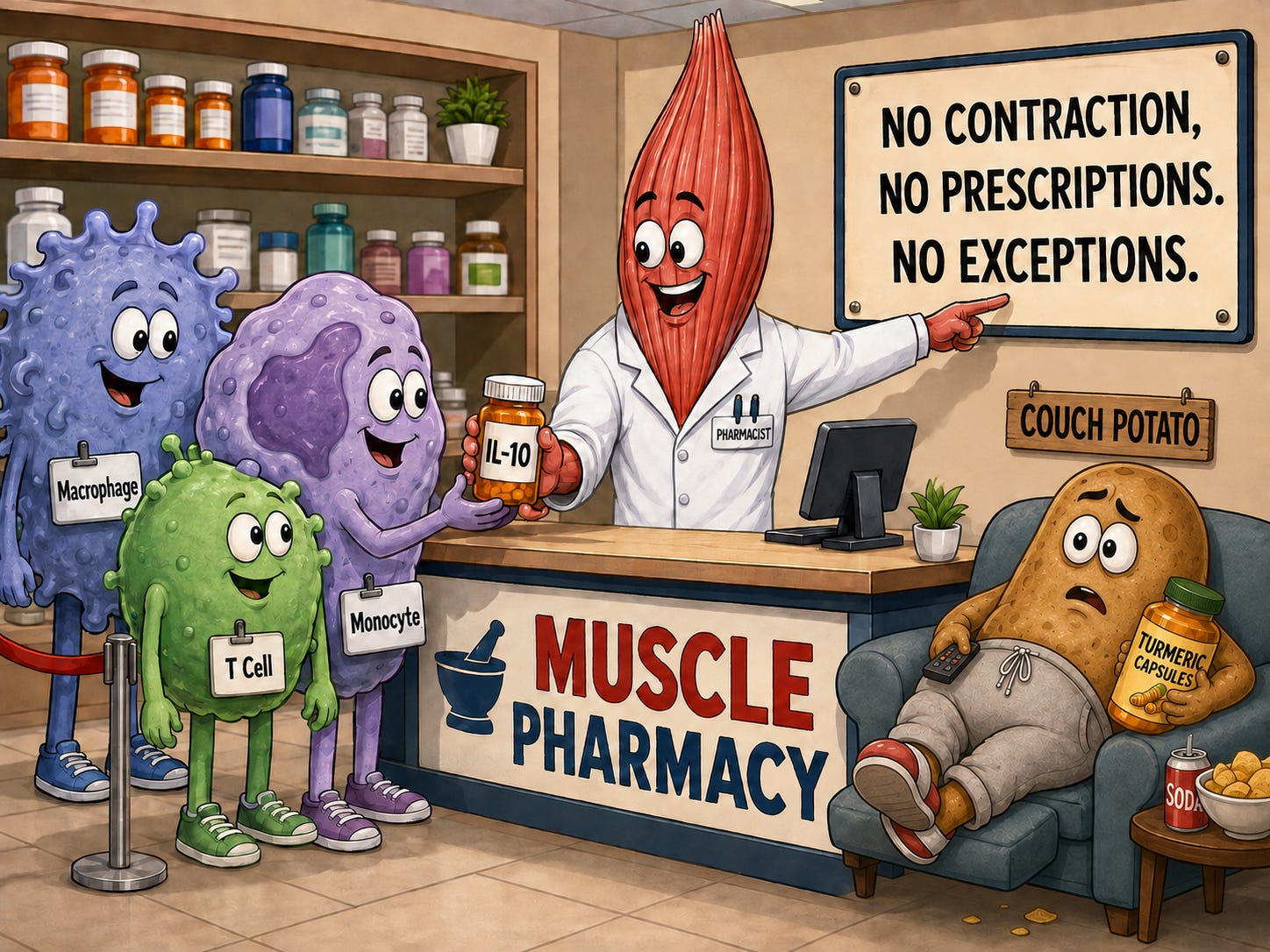
When IL-6 from contracting muscle enters the bloodstream, it reaches immune cells called monocytes and macrophages, along with several types of T cells. All of them respond by producing a different molecule called interleukin-10, or IL-10.
IL-10 does not come from the muscle itself. The immune cells are the ones that make it in response to the muscle signal, making IL-10 the prescription the muscle pharmacy fills for the immune system.
An infusion experiment demonstrated how this works. Healthy volunteers received a three-hour infusion of IL-6 at concentrations matching what their blood would carry during strenuous exercise, and that infusion produced an eight-fold increase in IL-10 and a twenty-six-fold increase in IL-1ra, another molecule that dials down inflammation. TNF-alpha, one of the primary drivers of tissue-damaging inflammation, did not change, and neither did temperature, blood pressure, or heart rate. The IL-6 signal, delivered at exercise-level concentrations, triggered the anti-inflammatory response without triggering the inflammatory one.
What does IL-10 do once it arrives? It shuts down the inflammatory gene program, suppressing the production of the signaling molecules that drive tissue damage when they persist, including TNF-alpha and IL-1-beta. The prescribed burn completes its work. The fire (IL-6) clears the understory, and the regeneration program (IL-10) activates immediately after, suppressing the signals that would otherwise keep the burning going.
Same molecule, opposite outcome
IL-6 from contracting muscle is anti-inflammatory. It triggers the production of IL-10 and IL-1ra without activating the classical inflammatory response, and a three-hour infusion of muscle-level IL-6 in healthy volunteers confirmed that it did not raise TNF-alpha, did not elevate adrenaline, and did not change body temperature or blood pressure.
IL-6 from fat tissue tells a different story. When IL-6 is released chronically from fat tissue, it accompanies TNF-alpha, travels alongside elevated C-reactive protein (a blood marker your doctor tests to measure inflammation), and marks the low-grade systemic inflammation that tracks with insulin resistance and metabolic disease.
Same molecule, opposite context. Muscle-derived IL-6 arrives as a transient pulse, released when the muscle fiber runs low on stored fuel during contraction, and it resolves within hours. Fat-derived IL-6 is released chronically, and the signal never resolves because the source never stops producing it.
A prescribed burn and a wildfire involve the same chemical reaction. The difference is duration and whether the system is prepared to regenerate afterward.
Duration, not mode
The IL-6 signal that drives IL-10 downstream scales with exercise duration. Duration is the single most important factor determining the size of the IL-6 response, and approximately half of the variation in post-exercise IL-6 across studies is explained by duration alone. The mode of exercise has little effect.
After a marathon, runners show a 128-fold increase in IL-6 and a 27-fold increase in IL-10, with the entire anti-inflammatory response peaking within the first hour after the race and remaining elevated for at least four hours.
A review pooling results from 24 comparisons of resistance exercise (weight training, machines, bodyweight work) points the other direction. The combined effect of resistance exercise on IL-10 was small and fell within the range that could be due to chance, even though the same analysis found clear increases in IL-6 and IL-1ra. That analysis measured blood levels at one moment only, the point at which the session ended.
The resistance sessions pooled in that analysis ran about an hour and still raised IL-6 and IL-1ra without raising IL-10. Sustained continuous movement produces the IL-6 signal that the IL-10 evidence rests on. Resistance training builds muscle and improves metabolic health through other pathways, and the case for it as an IL-10 lever has not been made.
Up Next. The Immune Resolution Protocol and Printable Worksheet
You now know the system exists. You know it requires a sustained IL-6 signal from muscle contraction, and you know that signal has to be long enough and large enough to trigger IL-10 downstream. What you do not yet know is what else feeds the system besides movement, what erodes it overnight, and which two popular anti-inflammatory strategies produce nothing at all.
Below, the seven-step Immune Resolution Protocol, the evidence behind each input, and a printable tracking worksheet.
Upgrade now to access.
